TAG: What a waste of time!
My son's Talented and Gifted program is a waste of
Can you tell I'm a little pissed off?

My son's Talented and Gifted program is a waste of
Can you tell I'm a little pissed off?
This morning I came across the Achievement First Charter School website. Not only does Achievement First appear to be highly successful, they have an excellent website that breaks down their philosophy, curriculum, expectations, and methods. One of the most interesting pages I came across was their "12 Lessons about School Reform". Here they are:
I would love to see whether this model would work in the poor rural areas of South Carolina. Most charter school systems have targeted urban areas, since there is more money to be made there. It would be more difficult to attract the quality of teachers to rural areas, and their money per student is a lot less than urban districts, but if these charter school systems are truly out to prove that their methods work universally then the "corridor of shame" is the place to do it.1. "These kids" CAN Learn
2. Leadership Matters - Mightily
3. Teachers Are More Important Than Curricula...
4. ...But Some Curricular Are Better Than Others
5. "Mere Mortals" Not "Superhumans"
6. An Unwavering Focus on Student Achievement
7. Interim Assessments and the Strategic Use of Data
8. One Hundred 1% Solutions
9. Serve ALL Urban Kids
10. Sweat the Small Stuff
11. Fidelity to a Clear, Consistent Model
12. Flywheel v. Doom Loop
More and more, I have been considering going in to education after my retirement from the AF in 3 years.
After my retirement, my plan is to use my GI Bill to finish up my Bachelors degree at the University of South Carolina. For a year now, while I have been knocking out general education classes, I have been trying to decide what to get a degree in. Mechanical engineering would be the obvious choice since it’s closely related to what I do now, but I still haven't made up my mind. I have also debated getting a degree in Math, but I am also interested in Education.
I wouldn't mind being a teacher, but seriously, I don't know if I could take the pay cut. Lately, I have been considering aiming for a degree in education psychology or research. I read so much about education theory as it is, I figured I might as well get credit for it. Perhaps I could teach for a few years and then move into administration... reform from the inside. Of course, if I did go into education, I know I would have trouble keeping my opinions to myself during all the education classes.
mellowman, one of my commenter’s made a great suggestion/remark.
He said he liked class websites that allow parents and students to see and/or download homework assignments.
This is one of those great ideas that would require an extraordinary amount of discipline from the teacher. Updating a website can be a time consuming practice, but the benefits would be immense.
Perhaps teachers should create a blog for each class. With today’s web based tools, it would only take a few minutes to create a blogger post and upload it to a website. They could do a short post outlining the homework assignments and any class notes. If they had electronic copies of any worksheets it should be relatively simple to upload it as well.
Just clarification of my earlier post Parental Struggles. The school imposed punishment is for one day of in-school suspension.
The idea to attend school with my niece is our punishment in addition to the school punishment. I can think of nothing more embarressing than having your uncle sit in all your 10th grade classes with you and hang out with you at school. I expect I will get some funny stares and a few smart ass comments, but we can not accept behavior like this. Besides, I will get to see the quality of teaching that goes on at our local High School, and I might even learn something.
Teachers, experts, parents... we need some advice/help.
One of our 3rd graders is behind in her reading comprehension skills. She is already getting after school tutoring that utilyzes computer based instruction, but we would like to know what else we can do to help at home. One idea that we had was to have her read out loud to us for her daily 15 minutes of reading and her reading worksheets, but we are unsure if this is the most effective method. Truthfully, we have limited time to spend hours of one on one instruction (6 kids, including an infant) and we can not afford private tutoring. We are looking for things that we can do to help her get more out of her current assignments and extra things we could do that take up no more than 20 to 30 minutes.
Niece busted for smoking at school. One day in-school suspension. In addition, I am going to take a day off work and sit in every class with her one day next week. Nothing worse than having a parent attend school with you. We also e-mailed every teacher of hers and let them know to report any misbehaviour, missed assignments, or unusual behavior.
I am disappointed.
"Parental involvement" it's one of those complaints that I run across frequently in the edublogosphere, but perhaps what we really need is more "teacher involvement".
A rough calculation shows that I have dealt with over 25 different teachers in my kids educational careers, and in that time I have seen a wide variety in the quality of teachers, the personality of teachers, and the style of teaching. I have seen strict disciplinarians, teachers that all students love, mother figures, burn outs, etc..., but I have made some observations about somethings that most good teachers have in common.
1. Organization. At the beginning of each school year we make an effort to drop in unannounced on our kids teachers, and one of the first things we notice is how organized their desk is. I know this might seem trivial, but we have noticed a direct correlation between the effectiveness of a teacher and their organizations skills. Teachers with messy desks are usually the same teachers that lose assignments, have trouble finding information if we ask for it, and are less likely to respond to notes from us.
2. Availability. Somehow, the good teachers always find time to talk to us when we drop in to see them. There is nothing more frustrating than playing note tag with a teacher when we are trying to get information or clarify something with the teacher. I recently had a teacher tell me to stop by after school to get some information, but when I did they were in the middle of a "conference". Don't tell me to stop by unless you know you are going to be free to talk with me... I work for a living.
3. Honesty. We know our kids aren't perfect and when we talk to/conference with a teacher we want to know exactly what our child needs to work on, the more specific the better. We don't want to know that our kid is "acting out", we want to know exactly what they did under what circumstance so that we can address it specifically with the child. If our child is struggling with something, don't tell us that they need help with "math" tell us that they don't know their "6x times tables".
4. Email. Everyone else in the world uses it, but for some reason teachers don't use it to help with communicating with parents. Instead of sending a note to school with a 1st grader, it would be so much easier if we could send a email and know the teacher was going to read it in a timely manner. In addition, instead of sending all those copied notes, send us an email, I know not every parent uses email, but a large majority do.
5. Pre-plan homework. We love teachers that give us all the homework for the week on the Mondays. That way we can have the kids work ahead if we know that they have a soccer game on Wednesday.
So teachers, if you work on your "teacher involvement" we parents will have an easier time working on "parental involvement".
Education is booming business. Google is entering the education world. They have created Google for Educators which is intended to be a clearing house for how educators can use Google tools to enhance education. Like Microsoft, they have their own lesson plans, but unlike Microsoft their lesson plans appear to actually teach kids.
Google Earth is the coolest thing since sliced bread and I have to admit I have spent hours on it exploring the globe. Google has partnered up with Discovery Education to provide some fairly interesting lesson plans that utilize Google Earth.
And no, I am not against technology despite my tirades against the School of the Future. Technology, used correctly, is a great tool to enhance content knowledge. Using Google Earth to help teach geography and history is a stroke of genius.
Microsoft can take a lesson, but instead they waste time with lemonade.
Here's what’s happening in South Carolina Education News:
The push for school vouchers continue to make the news.
Controversy over a recent decision by the State Board of Education to give the same status to "dual-credit" classes as to AP/IB classes for qualifying for state scholarships. Parents who go to affluent schools that provide these classes are against this decision. They make the point that AP/IB classes are tougher than "dual credit" classes. Unfortunately, not all students have access to AP/IP classes, so the scholarships help kids from affluent schools disproportionately.
Lexington 1 school district implements language immersion program. I think this is a great idea, and conveniently we were planning on moving to this school district in two years when I retire from the Air Force. It will be too late for most of my kids, but my baby daughter will be able to take advantage of it.
This morning I got to speak to my first grader's teacher. I asked her if they used phonics at all to teach reading. She told me that "they" don't like them (the teachers) to use any one method of teaching, but she tries to use a little phonics during the lesson. I also asked if they used any reading programs, and she said no.
In other parenting news... my 3rd grade son is getting braces today. Just in case anyone wants to feel sorry for me, do you know how much money I am going to spend getting five kids braces. Four of them will probably overlap having braces. I am going to buy the orthodontists' vacation house for him.
D-Ed Reckoning: Report from the First Grade Trenches
Seriously if you don't read KDeRosa's blog on a daily basis, you are missing the best commentary in edublogging on the net. Enough kissing ass.
Since I also have a first grader, I thought I would compare my child's school experience with KDeRosa's.
Math
In math, for example, they've only taken home about three homework assignments. One assignment asked them to draw pictures of things having numbers, like a clock or calendar. Another asked them to find a picture that told a math story--there are three dogs and two cats in this picture, how many are there all together.In math, I think our school does a little bit better. We get about 3-4 math worksheets a week. It started out pretty basic the first two weeks, but quickly improved. Last week, all of her worksheets were on addition and subtraction. She seems to have quite a good grasp of the subject, so I have no complaints yet.
I hesitate to call what's going on reading since there is so little actual reading going on. The kids were given a DIBELS test and broken up into reading groups. Whether they were broken up by ability, I do not know. Teaching consists mostly of letting kids pick out books they like and letting them "read" them independently. If the kids can't read yet, they can look at the pictures. That's nice.Our child is assigned 10 spelling words a week to learn. The words correspond with the words in her weekly reading story. She really stuggles with her reading, and seems to have no concept of phonics. Her teacher appears to be teaching her how to sight read. Unfortunately this means that she struggles with new words.
Girlfriend talks to district. Principal gets call. Dr. Counselor gets call, fixes problem, and apologizes.
Now wouldn't it of been much easier for him to hook us up at the beginning instead of having to get "talked to".
Also, niece is allowed back on cheerleading team. One rebel teenager turned into all american girl. We rock!
Peace
In my last post I said this: "I had to raise hell to get her enrolled in honors and college prep classes."
It appears I wrote to soon. When we got the hardcopy of my niece's schedule yesterday after school, she was NOT put in honors classes, despite Dr. Counselor looking me in the face and telling me that she would be.
My niece had some bad thing happen to her as a child that are still with her today. She is on daily med's to help her. The first semester of her freshman year she got into some "trouble". She was sent to us for her 2nd semester of school. Because we knew she was smart, we got her into honors classes despite her having terrible grades at her last HS. This is the results:
1st Semester Grades (She was absent most of the semester)
Math 69%
English 73%
NOTE: they actually gave us the highest "F" possible out of pity
2nd Semester Grades
Honors Algebra II 96% with a 98% score on the end of year exam -- year average 86%
Honors English 95% with a 100% score on end of year exam -- year average 87%
Honors Biology 82% with a 81% score on end of year exam -- year average 83%
NOTE: She wasn't in Biology in her first semester so her score on the exam reflects her literally only having 1/2 the course and having to teach herself the first half of the class!
With scores like this, we think that it is perfectly reasonable for us to expect her to have honors classes this year. It wasn't her or our fault that she had to attend another school for the first semester. She actually only got to attend 3 weeks of class at the school before she was allowed to sit out. (Long story, the situation was caused by lax parenting and a pyschologist that is ready to make any diagnosis that a parents asks for)
This is a school that serves a majority of disadvantaged students. Our niece, with the right parenting, can be a true success story at their school, but only if they help us help her.
Note: Not that it matters, but our Niece is Hispanic, so having her do well will also help them show that they are making gains on the "achievement gap"
Right now, my girlfriend is at the district office ready to raise hell with the district superintendent if that’s what it takes. I hope this gets fixed, because they have no idea the amount of fury that she can rain down on someone if they mess with our kids.
I have tried to avoid naming schools and people on this blog, but I have never been so tempted to identify the perpetrators.
I just got back from registering my niece at the local high school... what a frustrating experience. The school counselor was so condescending. I had to raise hell to get her enrolled in honors and college prep classes.
I also discovered that South Carolina uses some sort of block system. They have four periods a day. A class can either be a quarter class or a semester class. One semester class is equivalent to what I would consider one year of a normal class. For instance my high school math geometry class was a year long, but my niece's class is only one semester. Here is the conversation that followed:
Rory: So she could conceivably take two math classes in one year and do two years of math in one?Seriously, it just seems idiotic. If someone has 1st semester algebra I in 9th grade that finishes in January, they might not get to do Algebra II until the 2nd semester of 10th grade… a full year between courses that obviously build upon the previous classes foundations.
Dr. Counselor: Well actually no. Students are only allowed to take one core class of math or English a year.
Rory: Is it done like that in all of South Carolina?
Dr. Counselor: Yes, it makes it easier for students to transfer between classes.
Rory: Doesn't that affect how the students do in their classes, since many kids will have to wait anywhere from 6-months to a year between classes?
Dr. Counselor: Well maybe, but I have never looked into it.
Rory: Well I have seen the test scores, and that probably explains why South Carolina does so poorly on the SAT.
Swamp Fox Insights points to this great essay entitled Education Myths by Jay Green.
Allow me to paraphrase.
1. The money myth: Throwing money at schools alone does not improve educational outcomes.
2. The teacher pay myth: Teacher's salaries are competitive when compared with people with similar skills and qualifications. High-performing graduates aren't taking up teaching because there isn't enough incentive for strong performance or longer hours.
3. The myth of insurmountable problems: Don't blame social problems, reform schools.
4. The class size myth: The benefits of reducing class size aren't worth the expense.
5. The certification myth: Reward teacher's performance instead of certifications and "paper" degree's.
6. The rich-school myth: Private school's perform better than public schools, despite the average private school tuition being less than that of the public schools average dollars per pupil.
7. The myth of ineffective school vouchers: School vouchers really do cause public schools to improve.
While I agree with many of the author's points, I am not sure I agree with all of his conclusions.
One of the problems with many school reformers (of which I consider myself) is a tendency to come across as advocating "vouchers" and competition as the end all solution to improving our countries education system.
One of the arguments that reformers always use, is how our students perform internationally. Yet, there seems to be almost no effort to emulate the best practice's of some of the high performing nations.
“One half of the period you're learning math, the other half of the period you're learning science. But it all comes together,” said one student.So thats how to improve math and science performance; cut down instruction time. Duh... why didn't I think of that!
This is a $63 million project, and with so much emphasis on high-tech elements, you might expect that it would be more expensive than traditional schools. Officials say that is not the case.I see the accountants for Enron found new jobs.
New school, free laptops, no wonder so many kids want to go there. There's no entrance exam, only a lottery. Fifteen-hundred kids applied, 170 got in — most of them African-American. There is an exit exam of sorts — in order to graduate, they have to apply to college.Wooo hoooo, If I apply to graduate school, can I skip the rest of my college education?
Ditto.The ultimate test will be whether technology as tutor will actually help students learn.
My 16 year old niece is coming to live with us. She originally came to live with us in December of 2005 because she had several issues (stole car, failing every class, drugs... etc) and her mom couldn't handle her.
In six months, we managed to turn her into a church going, straight "A" student. This summer when she went home to stay, her mom (my sister) and us got into a "spat" over our parenting style (strict), so her mom decided to send her to Los Angeles to live with her grandma (my mom). We told everyone that this was a horrible idea, because my mom's is just to easily fooled and not that involved, but everyone said that she was "fixed" and gave the credit to the medication that she had been put on.
After less than 6 weeks after starting school she was slipping into the same old patterns. so she is coming to live with us again.
I know, I know... this means we will now have 6 kids but she is family and she needs us.
Me and Shannon know we can get her back on track. She just requires some parents who are involved with her school (we get weekly updates on class progress), and some parents that sent reasonable expectations and limits.
Our results speak for themselves. When she came to live with us last December she was literally failing Every class. We advocated for her at the local school and got her into the college prep curriculum. The results... Straight "A's for her last semester and "B's" and "C's" for the year. Our goal was to get her through 9th grade, and we did it.
What does this mean to my loyal occasional readers? Well 6 kids gives me even more creditablity and a high schooler means that now I get to criticize the upper grades as well as K-8. (sic)
So... I am off to Los Angeles later today and will return Saturday. I managed to get a next day round-trip flight for $250 to pick her up. Priceline rocks!
Response to Righwingprof comment in my last post:
rightwingprof said...
Except that testing had nothing to do with shop classes disappearing; the ever increasing pressure for everybody to go to college did, long before testing.
Completely agree.
First of all, standardized testing doesn’t and shouldn’t measure ever single subject taken in High School. It should evaluate students on basic core skills such as reading, writing, some civics/history, science and math.
CNN - Rebuilding shop classes in U.S. high schools
Vocational education classes, once commonplace, began to languish as standardized tests started to determine success and failure and college became a singular goal. Now called career technical education courses, they are beginning to enjoy a renaissance.This rocks... common sense in the school system.
...
Around the country, high schools are being transformed into career academies or adding smaller vocational schools within their buildings. In Chicago, Mayor Richard Daley recently announced an initiative that will let high school students become qualified to work in particular industries. Students would then use their certificates to find high-skill, high-paying jobs.
In keeping with the time honored tradition of shameless self-promotion, I have an article up over at edspresso commenting on a recent op-ed by The State newspaper.
I hate reading my own posts. Unlike 99% of education bloggers, I do not have a college degree, and while I think my blogging has improved since I started, but I am no where near the level that I would like to be on. So if your reading my blog, I would like to offer a heartfelt thank you for ignoring my spelling mistakes, poor grammar, and lack of expertise and reading my idea's (whether you agree with me or not).
The State 10/03/2006 College study ranks states K-12 system in the middle nationally
Gots to go to work... but the article is about this report.
Sara Mead responds to this article by Judith Kleinfeld over at the NRO, which critizes this report by her saying that the whole boys failing crisis is overblown. Her rationing:
Kleinfeld has to seize on this silly exchange because the actual reasons that I argue we should be cautious embracing "boy crisis" hype have nothing to do with "men oppressing women." Rather than falling, boys' achievement has actually increased over time on a host of measures. There are some places where that's not the case, and even where it's rising, boys' achievement isn't rising fast enough or as fast as that of girls. But that doesn't discount the fact that boys are doing better than in the past in many ways.Me thinks she doth protest to much. Lets have a little fun.
Kleinfeld has to seize on this silly exchange because the actual reasons that I argue we should be cautious embracingWow... that was fun, but I'm tired... you get the point, using this logic would allow us to ignore half a dozen other "gaps". Lets move on to see what she says next."boy crisis"the income inequality hype have nothing to do with"men oppressing women""rich oppressing poor" Rather than falling,boys' achievementpoor people's quality of life has actually increased over time on a host of measures. There are some places where that's not the case, and even where it's rising,boys' achievementpoor peoples quality of life isn't rising fast enough or as fast as that ofgirlsthe rich. But that doesn't discount the fact thatboyspoor people are doing better than in the past in many ways.
More significantly, I'm concerned that generalized fears about a boy crisis distract attention from the groups--students with disabilities, poor and minority youngsters of both genders (although the problems facing boys in these groups are more pronounced)--who suffer from much more significant educational gaps. And I'm concerned that a lot of explanations and solutions being peddled for the boy crisis are based on ideological agendas, misinformation, and little hard research--exactly the recipes for goofy educational practices and bad curricula that have been undermining our education system for years. There are perfectly good reasons to be concerned about the impacts of the boy crisis hype and some of its practitioners' recommendations for boys, leave girls out of it for a moment.Wait... is she saying that we shouldn't worry about boys because she doesn't like the solutions that boy advocates are proposing? Ok, I'm not an expert but aren't the usual boy crisis solutions single sex education, more male teachers, and different teaching strategies? Seriously, none of these solutions seems to be outrageous. Its not like people are proposing that we lock girls up and don't send them to school. Come to think of it, wouldn't most of these strategies help girls as well? (except for the lock girls up one :p) Wouldn't closing the gender gap also help close the achievement gap, since the gender gap is larger among minorities?
Its been fascinating--and disappointing--to me to see how conservatives, who are generally skeptical of conferring victim status, and critical of untested new educational ideas, seem to embrace both so uncritically when the "victims" are boys and the education "innovations" include single sex schools and implementing gender stereotypes in the classroom.Wait a minute here... who said anything about implementing gender stereotypes. I have not come across a single supporter of single sex education that has advocated "implementing gender stereotypes". Lets play our little game again:
Its been fascinating--and disappointing--to me to see howI couldn't of said it any better myself.conservativesliberals, who are generallyskeptical ofall for conferring victim status, andcriticalsupportive of untested new educational ideas, seem toembracereject both so uncritically when the "victims" are boys and the education "innovations" include single sex schools and implementing genderstereotypesequality in the classroom.
Interested in the Greeks? Start cookingWhile homeschooling began as a trend among fundamentalist Christians with largely religious motivations, unschooling is more about educational philosophy. It’s rooted in the belief that humans are naturally driven to learn and will do so fiercely if left to their own devices.Unschooling is difficult to define because no two unschoolers do the same thing.
Kike homeschoolers, unschooled children don’t attend traditional class. Unlike most homeschoolers, however, unschoolers do not follow any sort of curriculum. Children are allowed and encouraged to set the agenda and pace using their parents, their own lives and their homes and communities as resources.
So if they want to spend all day learning about bugs or gardening, they head outdoors. If they’re interested in criminal justice, parents might set up a visit to the police station or help them get books on the subject. If something about Greek mythology piques their interest, maybe they’ll cook Greek food or write a play about Perseus and the Gorgon. Or maybe not.
“Here’s how I define it: Unschooling is allowing your child as much freedom to explore and learn from the world as you can comfortably bear as a parent,” says Farenga, co-author of "Teach Your Own: The John Holt Book of Homeschooling."
Others have called unschooling ambient learning or child-led learning. Some call it bunk.
The LA Times has this op-ed up by Caryl Rivers and Rosalind C. Barnett on single sex education.
What they say:
Are single-sex classrooms the magic bullet that will produce academic achievement in public schools? Or are they simply a trendy idea based on bad science and even worse public policy? There's a real worry that the latter could be the case.I am way too lazy and stupid to tear up the article with a paragraph by paragraph rebuttal of their arguments, except to say I think its all BS. Luckily my lack of credentials allows me to refute all their arguments with the following.
Militant advocates of single-sex schools get a lot of ink in the national media but, unfortunately, little skepticism. Leonard Sax, bestselling author and executive director of the National Assn. for Single Sex Public Education, is spearheading the idea of vast gender differences in the brains and learning styles of boys and girls. Other "experts" confidently agree. But peer-reviewed studies and many of the nation's top researchers disagree. The American Assn. of University Women warns that not enough scientific evidence exists to show that single-sex classrooms improve student performance.Our own investigation finds that, too often, the claims made for great gender differences turn out to be highly exaggerated. Here are some examples:
[bla, bla, bla]
In matched pair analysis TWO 6th grade boys and girls showed a greater growth in scale scores on the 2005 PACT.I get it, I understand. Women’s groups are worried that once again they will be given the short end of stick when it comes to education. I have four daughters so I can sympathize. Any single sex education program in the country should be optional and benefit both genders. Unfortunately Rivers and Barnett have decided that single sex education is bad… under any circumstances. They conclude the article by saying:
We know that children learn in many different ways, but segregating them by sex will serve most of our children poorly.No exceptions, no qualifications. They don’t want us to have a choice. Enough said.
In the coming weeks I am going to be concentrating more on the race for the South Carolina Superintendent of Education between Jim Rex and Karen Floyd.
My hope is to provide impartial commentary to help myself and other SC voters decide between the two candidates.
Obviously, I waste spend a lot of time writing and reading about education, because I believe that education reform is desperately needed in this country. Both candidates are trying to present themselves as reformers, but the key is exactly how and it what way would they go about this.
As far as I am concerned, the only difference between the two so far is their positions on school vouchers and Governor Sanford's "Put Parents In Charge Act". Floyd is for it and Rex is against it.
I am somewhat ambivalent on school vouchers. I do not believe that school vouchers by themselves will encourage public school reform, but I am not vehemently against them. I worry about funding, private school tuition inflation, and the attached strings that would be on private schools if they accepted government money.
I am strongly in favor of charter schools, and not just charter schools that replace existing public schools. I want to see every parent in South Carolina have a REAL choice as to what school to send their kids too. There is no reason why we have to continue with our one size fits all approach to education.
Ahhh... the great NCLB debate. The NY Times has another article comparing NCLB accountability standards with that of Florida's A-Plus plan, entitled As 2 Bushes Try to Fix Schools, Tools Differ
NCLB was a great start in providing a standardized accountability system. While it's helpful, NCLB has several flaws; the use of widely varying state tests as its measuring device (I am in favor of National Standards) and its AYP provisions that are almost guaranteed to eventually label every school in America as failing. I need to research Florida's A-Plus plan more, but this article certainly makes a great point on how it's plan and NCLB can look at the same school and come up with two different results:It seems to me there are two different ways in which to rate schools: performance and progress. For example, consider the following illustration (assume the demographics are exactly the same):
R. J. Longstreet Elementary School here in Daytona Beach is an example. The tidy one-story building near the Atlantic Ocean has fallen short on the federal yardstick every year, but Florida has given it an A for five years straight.
It earned its latest A because on tests in spring 2006 tests 80 percent of students met “high standards” in reading, math and writing, and because 60 percent of students, and nearly 80 percent of the lowest-performing students, increased their scores. In August, the school received a $42,800 reward check.
“Congratulations on your outstanding performance,” Governor Bush wrote to the school.
But it fell short on 2 of 17 federal requirements, and that was enough to fail under the federal system. On a writing test administered to 55 fourth-grade students, 50 needed to show proficiency; 48 did. On math tests administered to 42 disabled students, 21 needed to score at grade level; 20 did.
In Many Public Schools, the Paddle Is No Relic - New York Times
As views of child-rearing have changed, groups like the American Academy of Pediatrics, the National Association of School Psychologists and the American Medical and Bar Associations have come out against corporal punishment.
“I believe we have reached the point in our social evolution where this is no longer acceptable, just as we reached a point in the last half of the 19th century where husbands using corporal punishment on their wives was no longer acceptable,” said Murray Straus, a director of the Family Research Laboratory at the University of New Hampshire.
Among adherents of the practice is James C. Dobson, the child psychologist who founded Focus on the Family and is widely regarded as one of the nation’s most influential evangelical leaders.
DuBose Ravenel, a North Carolina pediatrician who is the in-house expert on the subject for Mr. Dobson’s group, said, “I believe the whole country would be better off if corporal punishment was allowed in schools by parents who wish it.”
My blog's name is a cross between the words "parental" and "education"... so in going with that theme, I would like to give a little bit of parental education.
1. Set high standards for your children and they will live up to them. (be happy if they turn out just a little bit better than you did)
2. Always give more praise than criticism constructive criticism. (At least 3 to 1 ratio)
3. Teach them to do chores at an early age. (especially if you have 5 kids).
4. Hug them every single day... twice a day if you can. (more if your lucky, those teenagers don't give them out easily)
5. Set an example in ALL things. Always do right. (They will do as you do, not as you say)
6. Remember they can teach you a thing or two. (i.e. your not always right)
7. When they say "You just don't understand" no amount of argument is going to convince them that you actually do understand. (after all we could never have been their age)
8. Do everything in your power to avoid volunteering to be a soccer coach. (I have yet to heed my own advice)
9. Remember, when you are old, you will want the same amoumt of attention from them that they want from you now. (it might be the difference between a nursing home and an in-laws suite)
10. Take a break. Go have a beer. It really will help you put things in perspective. (beer got you through college, it can get you through parenthood)
Famous quotes from kids:
"Dad you look just like He-man, except he has muscles."
"Mom, did you have your wrinkles when you were a kid?"
Good evening
Don't install the new update. It will slooooooooowwwwwwww down your system big time. I have been fighting with my computer all day.
On the other hand, the new version of Internet Explorer aint all bad. Its finally got tabbed browsers.
GreenvilleOnline.com -Lifestyle-Here's how to get involved in your child's education - (9/29/2006)
Most principals and educators are passionately committed to teaching your children.Oh... silly me. I thought it was the schools job to teach children.
But ask these dedicated women and men what else factors into a child's school success, and you'll hear a rousing cheer for parents who are involved in what, and how, their children learn.
No homework, or not enough? If your child is not bringing home any homework (not all teachers believe in it), don't fret about lost opportunities to work together. Go online or to the library together to find books about topics being studied or get a jump on curriculum not yet covered.Hmmm... how about too much homework?
What a busy week... soccer games every night, my girlfriend has been studying for her nursing final, and I have been busy writing an upcoming article.
Lets sum up:
My son was out for two days with strep throat, so he missed his TAG program.... boo hoo. Sarcasm intended.
I wrote another note to my 3rd grade girls teacher complaining about the amount of homework she had... I was given a message in no uncertain terms was she going to change her policy.
My 6th grader has taken to algebra like a fish to water. She also is earning a 99% in her science class.
My 1st grader's teacher had to physically restrain a child who became abusive.
Oh... and I'm off to Myrtle Beach tomorrow.
I am not a native South Carolinian, but thanks to the cost of living in my native Los Angeles, the Air Force, and my girl friend, I have resigned myself to retiring here. Unfortunately, I have five kids that I am going to have to put through South Carolina schools.
Even though South Carolina scores around average on the NAEP assessment in 4th and 8th grade, we lag behind North Carolina when we compare SAT scores. South Carolina has a high SAT participation rate, but even when adjusted for income and demographics, South Carolina fairs poorly. As Swamp Fox points out in two recent posts:
Many of us who are more highly educated and affluent than the average South Carolinian smugly take comfort in the illusion that the problem is not us; average SC scores are low merely because we have lots of poor people. We believe, because we want to believe, that SC is last in SAT scores because there is a larger percentage of students taking the test in SC than in states with higher scores. That simply is not true.An in a post appropriately tited The elite of South Carolina do the most to drag down the average
- South Carolina students in households with annual incomes above $100,000 scored 68 points below the national average.He also links to a great report on education from the South Carolina Policy Council by Edward J. Coulson entitled Achievement in Context: How South Carolina Students Fare Against their National and International Competition.
- Those from families earning below $10,000 were 63 points below peers nationally, the College Board data show.
Nor can it be said that America’s poor overall performance at the end of high-school is due to a large contingent of low-achieving students. In reality, there is no subject, no test, and indeed no grade, on which America’s best students are the world’s best students. At the 12th grade, America’s top students place dead last when compared to top students in other countries – implying that South Carolina’s highest achieving high-school seniors are, in reality, among the worst of the worst.Later in the conclusion, there is this dire summary:
Another pattern of note is that South Carolina’s performance relative to the nation at large deteriorates at the high-school level. At the 4th and 8th grades, South Carolina is at or somewhat below the national average. Its average rank across NAEP 4th and 8th grade tests is 13th from last in the nation. By the senior year of high-school, South Carolina falls to last place on the SAT and second from last place on the ACT.Depressing…
…
Finally, it should be re-emphasized that South Carolina has one of the highest, or even the highest (depending on the method of calculation), dropout rate in the nation. As a result, the already unflattering performance of its high-school seniors likely exaggerates the actual academic abilities of their age cohort, relative to other states.
An even greater concern in this era of global competition is that, as South Carolina’s students are falling to the bottom of the national heap, so, too, is the United States falling to the bottom of the international heap. In fact, the nation’s academic performance on the world stage mirrors that of South Carolina on the American stage. American students perform at about the average of industrialized nations at the 4th grade, consistently below average at the 8th grade, and at or near the bottom by the 12th grade. Thus, in order for South Carolina’s young people to be truly prepared to compete in the global economy, they would have to far surpass the average achievement of America’s high-school seniors. Regrettably, they do the opposite.
I had to call my 1st graders school today to let them know that she would be parent pickup. This is what you hear when you first call...
"Thank you for calling [blank] Primary School, home of the [blank], where we are touching future educators, doctors, lawyers, field laborers, and other career choices."
I had to call back several times to make sure I hadn't misheard. Am I right to be worried?
Safety Concerns For School Of The Future Students
The 170 freshmen at Philadelphia’s High School of the Future have been advised to give up their school-issued laptop computers, if threatened.
The students at the High School of the Future are among nearly 300 in Philadelphia schools with district-issued laptops. They may carry them to and from school, but it’s often through high-crime neighborhoods. The district has bought insurance for the laptops and software that allows any missing laptops to be traced.
Over the next two years, the Philadelphia School District plans to have 25-thousand laptop computers available to students and nearly half of those will go home with students.
With such a hot commodity, many parents are concerned about the safety of students traveling to and from school.
You know the great thing about having a blog, is having commenter’s. I consider myself especially blessed to have several readers that are way more intelligent than I am, and who are willing to keep me on the straight and narrow re education. Obviously as an education blogger, with no teaching experience, limited reading on the subject (I am slowly fixing that), and no formal training, I have a lot to learn. It’s been my experience that some of the most useful sources of learning are actually in the comments of blog postings.
In my last post, rightwingprof’s pointed out that constructivism does have its uses. I realized my last post was an over the top satire of the problems with constructivism. It inspired me to do a bit of reflection on what and where I think constructivism might be useful and not so useful in my own children’s education. So in a nutshell here are a layman’s views on where and when constructivism might be useful is a K-8 situation, since its obviously not applicable to soccer coaching :)
Book reports and literature analysis is one of the areas that I think constructivism could be useful in promoting higher level thinking. Once a learner student digests a book, the student has to take what he has read and somehow relate his understanding of the world with the new knowledge, concepts, or themes that he identified in the book. Critical thinking here is key, because different students are going to read the book with a different world view or idea as to what is important in the world. Because of this, you can’t just instruct or drill into a student what the underlying message or themes of work of literature are. To properly interpret literature, it is probably useful to be involved in some group discussion and to learn by trial and error. Unfortunately, analyzing literature is one of those skills that doesn’t lend it self to standardized multiple choice testing. A certain amount of comprehension is going to be testable, but higher level critical thinking is probably best judged on a subjective scale… i.e. book reports, essay questions.
There are several other uses that I can see constructivism being useful, such as science application through science experiments and identifying themes in history. Of course I think at the K-5 levels of education, constructivism should be used mainly as a temporary diversion or break in routine, and used only to tie together content knowledge that has been mastered. Having said this, it’s probably mathematics that I have the hardest time seeing any benefits to constructivism. I am sure that some people would argue that constructivism teaches the application of math skills, but it seems that the schools try and teach applications way to early in a child’s educational career. Unless the mechanics of math are understood intuitively, it seems like any sort of “discovery” learning would serve no purpose.
I have decided to convert to the dark side and embrace the obvious superiority of constructivism and "discovery" learning. I started with my 7-8 year old soccer team. Instead of traumatizing the children by teaching them meaningless skills like kicking and dribbling, now I just give them the ball and tell them to discover the game of soccer on their own. I don't even bother explaining the rules because as we all know soccer rules were developed by an elitist white European culture. Instead, I let my kids create their own rules. To protect their self-esteem, each player earns a goal by breathing. One breath = 1 point. To address individual learning differences I have scheduled 17 different practices, because every kid is different. Since games (the sports equivalent of standardized testing) are culturally biased and ran by obviously prejudiced sexist referees, I developed my own measure of success. I rated my kids against kids who learn by a more regimented style, my kids came out on top. For each kid who picked up the ball with his hands thereby demonstrating creative thinking, I awarded that style of learning a point. In depth analysis of my study proved that my style of coaching had a positive effect of 1 million standard deviations. My next step is to write a book...
Originally posted on D-Edreckoning in response to Conceptualize This, also see his post on Chicken Porn.
The Nerd, Geek, Dork test.
I am "Joe Normal"
For The Record:
A Nerd is someone who is passionate about learning/being smart/academia.
A Geek is someone who is passionate about some particular area or subject, often an obscure or difficult one.
A Dork is someone who has difficulty with common social expectations/interactions.
You scored less than half in all three, earning you the title of: Joe Normal.
This is not to say that you don't have some Nerd, Geek or Dork inside of you--we all do, and you can see the percentages you have right above. This is just to say that none of those qualities stand out so much as to define you. Sure, you enjoy an episode of Star Trek now and again, and yeah, you kinda enjoyed a few classes back in the day. And, once in a while, you stumble while walking down the street even though there was nothing there to cause you to trip. But, for the most part, you look and act fairly typically, and aren't much of an outcast.
I'd say there's a fair chance someone asked you to take this test. In any event, fairly normal.
Congratulations!
Yes... I love my job. There are so many things out there to comment on; unfortunately I am intellectual Jell-O today. Instead, since this blog is about school from a parent’s point of view, let me give you a run down my experiences with the system this week.
On Tuesday, one of my 3rd grades started reading tutoring finally. She makes great grades in class, but has problems with the PACT test. She use to be in reading program when she was in another school district in 1st grade. When she transferred to this school district, they didn't have a reading program available, so she didn't get the extra help she needed in 2nd grade. Luckily we raised enough hell, and her teacher supported us this year. She really enjoyed her first day... her reading teacher is my son's 3rd grade teacher. Hopefully they gave her an initial evaluation, so we can track her progress.
My son started the Talented and Gifted program on Tuesday, and I stopped in to meet the teacher. It was as bad as I feared. His TAG teacher has a degree in Art and when I asked her what her plans were for the glass, she told me she was going to teach using Art. I started asking some hard questions about what exactly they were going to learn, especially in Math, and already know who I was already. It seems the testing coordinator had already warned told her about me. I did manage to get her to verbally commit to providing accelerated math instruction, but it was like pulling teeth. We will see what happens.
Non school related:
Both of my 3rd graders scored goals in their soccer matches... I’m such a proud daddy.
Well, I’m going to surf around and see if I can find anything interesting to say.
Via Kevin Drum over at Washington Monthly: Connor Clarke at the American Prospect thinks the recent debate over homework an exercise in futility. He connects the homework debate to the achievement gap.
When it succeeds, homework is, in those rare instances, the poster-child example of an educational policy that overwhelmingly advantages rich students with well-educated parents. This shouldn't come as a shock, since homework, as its name implies, is usually done in the home. That is where differences in class, education, and family structure are starkest. As Richard Rothstein details in Class and Schools, those differences are not slight: Disadvantaged parents are less likely to help their children and, when they do, their help is likely to be less valuable. Affluent children are likely to have rooms or workspaces of their own, while many underprivileged students must carve out a nook in more crowded housing. And when they do so, they aren't apt to have computers or reference books on hand to help.
The point here is not that debates about educational policy are always a bad thing. Abolishing or reforming homework might be a worthwhile project, and it will doubtlessly increase the aggregate happiness of a certain demographic. But such reforms are always doomed to have a limited effect; the developmental impact of wealth and family is simply too great to ignore. So go ahead and scrap homework. (And, while you're at it, build me a time machine back to high school.) Just make sure you get rid of economic, social, and racial inequality, too.
But such reforms are always doomed to have a limited effect; the developmental impact of wealth and family is simply too great to ignore. So go ahead and scrap homework. (And, while you're at it, build me a time machine back to high school.) Just make sure you get rid of economic, social, and racial inequality, too.
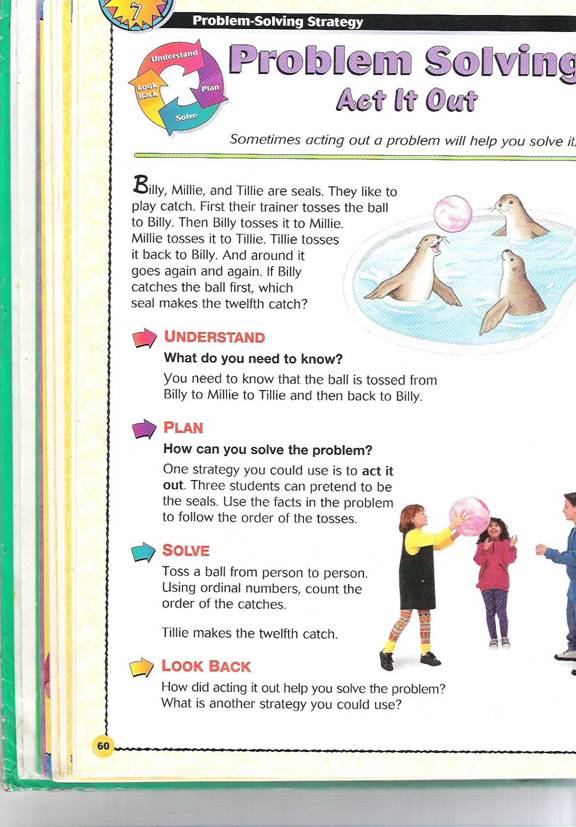
Image from Mathematics: The Path To Math Success! by Sivler Burdett Ginn page 60.
I promised I would post an image of my 3rd graders math book. Hopefully I don't get in trouble for copyright infringment. The page is on "acting it out as a problem solving method". I suppose thats one method. On closer examination of the text book, I confess that its not as bad as it could of been. I do have some problems... it skips around from geometry to multiplication to estimations to division. There is way to much review at the beginning of the book. It also ends with one digit by two digit multiplication and division. I would think that most 3rd graders given proper instruction would be able to move beyond this by the end of the year given better instruction.
Update: I realize its hard to read the image. The problem is about three kids tossing the ball in a circle. Who has the ball after the 12th catch. The suggested solution, act it out.
Update #2: I found a great site that reviews math books. My 3rd graders book is Mathematics: The Path To Math Success! from Silver Burdett Ginn. The review is of its 2nd grade version is over here at www.mathematicallycorrect.com.
Overall Evaluation [3.4]
Students using this program have a reasonable chance of moderate achievement levels. On the other hand, this program is not seen as supporting high achievement levels. It is possible that a skillful teacher could overcome some of the limitations of this program and use it more effectively. The heavy reliance on models and the potential confusion in the treatment of perimeter are examples of areas where an effective teacher could improve upon the student learning supported by this program.
KDeRosa has a great post up on the latest editorial “Critical Thinking, Not Standardized Tests” over at the Los Angeles Times. He does such a great job, that I am not going to even bother covering the content of the editorial…
Of course, as you may suspect, I am a master googler. Using my awesome skills, I decided to look at the background of the author who would write:
In fact, test scores (on the annual standardized state test) are like the closing prices on the stock exchange. They fluctuate for any number of reasons. A bad breakfast, a case of the jitters or skipping a line and filling in the wrong bubbles can wreak as much havoc as not knowing the difference between "abjure" and "adjure."
His teaching philosophy is to reinforce
the reading, writing and math
with as much music, art, drama and
dance as possible. His goal is to
make the classroom a place of delight
and joy; then learning will seem an
extension of that. When learning is a
joy, everyone benefits.
So I finally fixed my blog. I like this look a lot better than the one I had to resort to temporarily. I also added Right Wing Nation to my blog roll. I don't necessarily agree with all of his politics, since I am a left leaning moderate politically, but he raises good points and I agree with 99% of his views on education.
Though rightwingprof's post entitled "Diversity Destroys Education" might be misleading, he makes some excellent points. He ridicules the notion that teachers should tailor their instruction to individual students, pointing out that it’s simply not possible for a teacher to cover all the information multiple times to cater to different types of learners. He concentrates on how the progressive constructivist view on education is especially not appropriate to math education.
Allowing multiple [teaching] methods encourages failure — because, again, math is wholly linear, and skills build upon other skills. Allowing students to "own" math means not teaching them math at all.
The linearity of math means that there is exactly one method, and only one method, for any given skill:2 that symbol manipulation which must be mastered not only to solve the current problem, but to master other skills down the road. It makes no difference if little Johnny would rather glue macaroni on toilet paper tubes. It makes no difference if little Michelle is a crayon project-oriented learner. Only one method accomplishes the entire reason for teaching the skill in the first place.
Sorry had to change the look of my blog. For some reason, the old template wasn't showing up correctly. The column on the left was displaying on the bottom of the page. I didn't have the time to try and troubleshoot it.
Last night while talking with one of the mothers of a kid on the soccer team I coach, she told me about her son’s class at the same primary school (K-1) that my daughter goes to. Starting out with the phrase “I’m not prejudice, but…) she complained about how the school needs to ensure diversity. It seems she is unhappy that her son is the only white kid in his classroom. The school is about 50% white and 50% black, and she reasoned that the school should ensure that the school should ensure that all classrooms should reflect this ethnic makeup. Her argument was that her son felt “different” in his class.
First let me say that I have had three kids attend the same school and I have always really liked the school. I loved how they were only a K – 1, the administration was always helpful and friendly, and the teachers genuinely care about providing a quality education (even if they don’t use the most effective methods). I have never noticed the ratio of ethnicities in my kids in the school and frankly never paid attention. I am much more concerned about whether there were disruptive students of any race. I am positive that our school assigns classes randomly and his class was just a fluke.
It saddened me to hear an otherwise kind and educated person complain about ensuring diversity, when it didn’t take a genius to realize that it was her own racism that was behind the complaint. I know her son and like most 7-year olds, he couldn’t care less whether his fellow students were black or white, but all she saw was color and class. I am positive if his class was mostly white that she wouldn’t mind at all. Her son’s academic’s is going to be determined by the effectiveness of the teacher, his natural learning ability (yes I mean IQ), and how much supplemental effort she puts in at home, not whether the child beside her has the same pigment of skin.
Someone has decided to compete with Microsoft's lesson plans. See my previous post.
From the Radical Math website: "Radical Math is a resource for educators interested in integrating issues of social, political, and economic justice into math curriculum and classes..."
On how to integrate social justice into math:
-- The Basics --
It is important but not necessary that all projects and units have a solution-based component. Don't just focus on the problems your students and their communities are facing - it's the creative solutions we're generally short on. So one of your goals should be for students to understand the issues and think about how to solve them.
In other words, the important thing is not that you have actual math, but a political agenda that at least has some numbers... any number will do.
From the Trenches of Public Ed.: Rosy Rhetoric From a Pro-Public Ed. Person
In response to Dennis at The Trenches of Public Education and his rosy outlook of public education
http://www.act.org/path/policy/pdf/ready_to_succeed.pdf"Nearly 75 percent of U.S. high school graduates enroll in college within two years of graduation,1 yet only 56 percent of 2005 high school graduates who took the ACT® test took a core preparatory curriculum in high school. And even among those who report taking a core high school curriculum—four or more years of English and three or more years each of math, social sciences, and natural sciences—a significant number are still not prepared to succeed in credit-bearing first year courses." “Nearly one-third of students entering some type of postsecondary education need to take remedial courses in one or more subjects because they lack the skills to take standard credit-bearing courses. This figure balloons to 43 percent for students entering predominantly minority colleges.”
http://findarticles.com/p/articles/mi_m0DXK/is_5_20/ai_101413754Degree Attainment Rates at American Colleges and Universities," prepared by education professor Dr. Alexander W. Astin and doctoral student Leticia Oseguera, found that among freshmen that entered baccalaureate-granting colleges in fall 1994, only 36.4 percent were able to complete their bachelor's within four years. That compares to 39.9 percent a decade earlier and 46.7 percent in the late 1960s. The degree-completion rate jumps by nearly two-thirds, to 58.8 percent, for students taking six years to complete college, and to 61.6 percent when including those enrolled after six years are counted as "completers."
Let’s put this in to perspective. Out of my 5 kids, 1 will not graduate high school. Only 3 out of 4 of the HS graduates will enroll in college. 1 of the 3 entering college will need remedial education prior to taking basic courses. Only 1 out of my 5 kids will graduate college in 4 years, another 1 will graduate in 6 years. The 3rd will drop out. I started out with 5 kids, and only 2 of them managed to graduate college. Am I a successful parent? Personally, I hoped for better.
When we talk about whether schools are failing or merely need improvement, it’s all semantics. We need to ask ourselves if this scenario is acceptable or whether we could do a lot better than this.
My 1st grader forgot her reading book for the 2nd day in a row. Yes 1st graders have reading books.
My 3rd grade son went to his first day of TAG… its not looking good. On his first day all they did was write a mini essay on them selves. I received a letter from the Teacher introducing herself. She is an Art major. I swear I will pull him out of the program if they don’t do some actual teaching.
My 3rd grade daughter had to much homework again. She had 10 sentences to write (30 minutes), math worksheet (20 minutes), and reading worksheet (1 hour). We skipped her 15 minutes of reading since we had soccer practice, but still 1 hour and 40 minutes of homework at 8 years old.
My 6th grader had pre-algebra. She actually took to it very quickly and enjoyed it, although she struggled with her multiplication facts still.
TAG... I was really really hoping it mean talented and gifted, but I'm not so sure anymore. Today I got home a letter and permission slip for my son's Academically Gifted and Talented Program which he starts tomorrow. Imagine my disappointment when I learned that in his Lookout classes, my child will:
"work on interdisciplinary units and other activities that are designed to develop creative and critical thinking skills, independent learning procedures, communication skills, and group dynamics."
I dont even know what this means. This is exactly the sort of edubabble goobly gook that I can't stand. My son doesn't need independent learning procedures, he is 8 years old for god sake. Group dynamics!!! I am pretty sure that my son qualified based on his math scores, not his social skills. Is it so hard... say it after me slowly... "acceleration". It says right in South Carolina Regulation 43-220, Gifted and Talented, paragraph II A. 2. (D), that the one of the purposes of the program is to provide "a confluent approach that incorporates acceleration and enrichment". ac‧cel‧er‧a‧tion 1. the act of accelerating; increase of speed or velocity. As in... teach things at a faster pace so that he could learn more in less time. Its a pretty simple concept. Now I can understand a little bit of this whole child centered learning junk might be useful with gifted children, but couldn't they include just a little bit of "acceleration", just a little. My son is capable of learning 4th and 5th grade math, but will he get to? It doesn't look like it. Instead my son is going to learn "communication skills". Oh well at least he will be able to easily tell me how bored he is.
Philadephia’s School of the Future (SOTF) has taken a few knocks lately. First D-Ed Reckoning says it will “all end in tears”, then rightwingprof calls the curriculum “mindless old crap”. Now it’s my turn.
Rightwingprof pointed out that in the Reuters article on the SOTF that the new Principal Dr Shirley Grover is quoted as saying"
"It's not about memorizing certain algebraic equations and then regurgitating them in a test," Grover said. "It's about thinking how math might be used to solve a quality-of-water problem or how it might be used to determine whether or not we are safe in Philadelphia from the avian flu."
Laughing yet? Perhaps she just happened to give a bad example. Surely they aren’t going to have lesson plans this inane. I mean after all the SOTF is partnered with Microsoft and there is no way a multi-billion dollar technology company would encourage such nonsense. Alas, things are as bad as they seem. Being the google master that I am, I managed to find Microsoft’s SOTF website. It seems Microsoft has its own education site with lesson plans for teachers, nicely divided by subjects. Some examples:
Under the Mathematics category we have:
Making Money From Lemons which calls for the instructor to “Tell the students to go into the lemonade stand business. Each of them will own their own business and make decisions about materials, costs and how to make the lemonade. They should also know that even if they have really good tasting lemonade, sometimes the weather affects how much lemonade people buy. They will get to see a weather forecast, but they should keep in mind it isn't always accurate.”
And of course the infamous How Much Water Does Your Family Use? where students use excel to track their water usage and compare it to other students.
Microsoft just doesn’t cover mathematics though, they also have History lesson plans entitled History and Culture through Food and of course What is Jazz? All major subjects are covered. Language Arts, Social Studies, Science, etc…
Well the kids might not learn how to use the quadratic equation, but at least when they graduate school without any basic math skills they can always open up a lemonade stand and track how much water they use with Microsoft Excel. After all if food can be part of history, why can’t lemonade.
Dennis over at The Trenches of Public Education has been doing his homework. He regularly butts heads with Kevin over at D Ed-Recknoning, and today posted an article addressing their disagreements head on. In it, Dennis says the following:
KDeRosa's tirades against public schools are based on his contention that we are using faulty teaching methods, and he makes constant references to something called "Project Follow Through." At first, I didn't know what he was talking about.
And then…
I spent about three years taking classes to earn a Masters, and I heard lots about cooperative learning, multiple intelligences, and all that other progressive stuff. During all of that I never even heard Direct Instruction mentioned. (Neither was the name, E. D. Hirsch, or the term, cultural literacy.) If the articles I've read on Project Follow Through are at all true, and Direct Instruction performed that much better than the other methods, how in the world could this have happened?
I will be truthful here. When I read this last paragraph, I honestly thought that Dennis was being sarcastic, but apparently not… because he goes on to say
But if there's a teaching method out there that can help us be more effective for more kids--possibly much more effective--why aren't policy-makers and education schools telling us about it?
And
Although I don't think any teaching method will make as big a difference as he believes, I'll take any improvement we can get. I think a lot of us should be taking a very good look at Direct Instruction.
I suspect that many teachers won’t have a choice but to take a look at DI. NCLB flawed or not is here to stay. Eventually it will force schools to use every trick and/or method at their disposal to raise test scores. Even schools in affluent neighborhoods are in danger of being called failures due to AYP requirements. The current trendy educational methods have ran their course and proven to be ineffective at improving the scores of disadvantaged children, there is no where left to go but to models such as Direct Instruction. With the increasing popularity of charter schools and advent of school vouchers on the horizon, public schools are going to have to go back to the drawing board. There will be a lot of discontent but eventually you can’t fight science and research, only delay its implementation.
Finally let me say, that I admire Dennis greatly and he and I have some great debate over various issues. I am especially impressed that he took the time to research a subject with an open mind. Even though I am a critic of the current educational system, it is because of teachers like Dennis that I am encouraged that our system can improve. We can argue all we want about constructivism vs. Direct Instruction, but when it comes right down to it, our children depend on dedicated professional teachers to make it all happen.
On a related note, please forgive my blatant grammatical errors and spelling errors I made when commenting on Dennis's blog. I had been watching the Ohio State kick Texas ass and had a few beers :) By the way, just to clear things up, I am a USC fan.

