Saturday, February 24, 2007

RedKudu: Saturday Circular

RedKudu: Saturday Circular

I am an education blog surfing fool. It's actually pretty pitiful since I actually do have a real job which has nothing to do with education. I continually run across new blogs though, and recently came across RedKudu, an english teacher with an attitude in Texas.

Though I doubt that I get much traffic that hasn't read her, just in case I want to point y'all over there to check him/her out, especially her Saturday Circulars.

Also check out her post entitled "Teacher Makes Students Cry"

Last week, I began a Stanford Experiment-inspired activity with my seniors, who are reading "Lord of the Flies." It was my intent to introduce to them the concept of group mentality, and the effects of unchallenged rumor and unquestioned leadership - all leading (hopefully) to a greater understanding of the behavior of the boys on the island. Friday I assigned them a simple project, a pamphlet about survival skills which I am later going to use to pave the way to their major research projects next six weeks (it's undoubtedly artsy, but it will have far-reaching impact). Then I allowed them the period to read silently, and begin working on the project.

Near the end of class, I removed a small group of students I’d been observing who had worked consistently all period, took them out in the hall, and told them I wanted them to go back and tell their friends that I had told them they didn’t have to do the project. But I warned them I wasn’t going to tell the other students anything about it. They all willingly agreed to be a part of the plan. (Note, none of the other students had behaved badly, but some had been off-task for some portion of time, and some had turned secretly to other homework. I knew they would later pinpoint this as the reason they were excluded.)

I’d intended for them to wait until they were outside of class, but didn’t time it quite right. A few of them asked their friends quietly what had happened out there, and they were told. The tension (and rumor) rocketed around the room as I pretended to be completely unaware behind my desk. When the bell rang, there were some choice words for me muttered under breaths, which I pretended not to hear.
You will need to click over to read the rest of the story, but it was quite an experiment. It also a perfect example about how to challenge students minds, open them up to new ideas, and instill critical thinking skills. If only we had more teachers like RedKudu.

Friday, February 23, 2007

Reform Targeting

I posted this over in comments at From the Trenches of Public Education.

When I started researching education and entered the edublogging realm, I was a blank slate.

I believed in many of the standard talking points. Preschool will fix everything, all we need is more money, etc..., but was open minded in general.

My thoughts and opinions evolved (and still do) as I learned more.

I am now pretty much in the "drastic reform" camp, but I don't think I have ever been a big proponent of H.S. level reforms. I do like the idea of smaller schools, or at least schools within a school, since I think having stable relationships with teachers is a pretty good thing for students. I think there should be a bit more ability grouping, though with honors, college prep, and regular classes there is some. Having said that, I think that High Schools do a pretty decent job of teaching those who come to them on skill level. Basically for the top 50% to 95% of students, our High School program works relatively well.

It's the lower 50% that really needs educational reform, but by HS they have pretty much already been broken.

In the military we see all sorts of fads as well.

We had Total Quality Management for a while, now the latest fad is ATSO 21 (Six Sigma)... all adaptations of the latest business models out there. Like you, we as workers roll our eyes, try and take the best of the theories and await the next reform.

So I understand the resistance to school reform advocates.

I think a major problem for reform advocates has been an inability to separate the education system into component parts.

Different levels of education need different amounts and type of reform.
Perhaps it is the union mentality of teachers, where HS teachers react negatively to reform targeted at the elementary school level.

I still think there is something to the idea of enlisting HS teachers as allies in the push for K-5 reform.

Certain principles of "di" are going to be universal (the military uses a lot of elements of it teaching recruits), but its probably most critical at the early basic skills level to rely on scripted programs.

I think there probably is a critical mass point where scripted programs can give way to more flexibility in teaching freedom after kids have learned to read and compute at a certain level. It is probably at this point that kids really have been taught how to learn (such a cliche).
Certain concepts of "di" though are certainly worth incorporating into all levels of education. Things like breaking concepts down into components, ensuring mastery, reinforcement of concepts over a period of time, and ability grouping.

Secondary school teachers differ from elementary school teachers. They are usually (or should) have degrees in the content area they teach, more like college professors than elementary school teachers.

I suspect that utilizing DI and scripted programs, a school full of Junior College graduates could outperform our current elementary school programs.

(Cross posted)

Wednesday, February 21, 2007

Update on my kids and us

It's been a while since I update my regular reader (thank you Bob) on the progress of my kids.

1st grader: I had a meeting with her teacher last week to express my concern about her lack of decoding skills. Her teacher told me that she knew Skye struggled, but half of her class was even further behind. I did get her to guarantee me that she would be enrolled in the after school reading tutoring program starting next month. I think I scared her...

3rd grade girl: Christina has really improved in reading since the beginning of the year thanks to the reading tutoring program. She now completes reading worksheets that use to take her an hour in 15 minutes.

3rd grade boy: I sat in on his TAG pullout program last week for 15 minutes. 20 odd bright kids wasted the whole time coloring repeating patterns of shapes in the name of enrichment. Today, after he had finished his worksheet in math on odds, I managed to teach him factoring. He also impressed me by remembering how to reduce fractions, even though I had only showed him how to do it once before while we were driving to a pick up pizza. He needs a bit more practice to master it, but it shouldn't take long.

6th grader girl: She got an "A+" on her science project two weeks ago. She used pendulums with different weights to prove that gravity pulled equally on objects of different weights. She is definitely our little scientist.

Me. I am coasting through my online psychology class. It is only a Technical College, but it's amazing how easy the course is.

GF: Shannon is about to finish her 3rd to last nursing course. In August she will graduate, and then its the big bucks.

Us: I have put in for orders to Alaska. I will find out in a few weeks if I got the assignment. If I do, we will move sometime in August. It will give me a whole new state's education system to bash.

Monday, February 19, 2007

Blogging Frenzy

I have to admit, I am taking a small part of satisfaction at the blogging frenzy that I had a small part in starting off.

Dennis asked me if I knew of any teachers who had implemented DI.

It must of started him wondering, because he decided to ask his readers about it.

As I indicated earlier, it is hard to find anyone who is more critical of American education than KDerosa, and much of his criticism is centered around his belief that we are using the wrong teaching methods, especially at the elementary level. I would love to hear from any elementary school teachers who know more about Direct Instruction than I do. I'd especially like to hear from teachers who have used Direct Instruction after using other methods. I would also love to hear from teachers or administrators who know why so few elementary schools use this method. It is a mystery to me why I've heard so much about Direct Instruction from parents, like KDerosa and Rory, and so little about it from teachers.
After that it snowballed. Joanne wonders about the same thing as Dennis.

RedKudu notes that the education system is biased against DI. (I just discovered RedKudu, but it is an excellent blog).

This is how I was taught I should be suspicious of direct instruction styles, and why I believe many teachers may not be aware of what direct instruction is, especially if they're getting the same information I did. The teacher-centered classroom, I was told, is also sometimes called "direct instruction." Did the presenter have a grudge or some bias? Probably. Was the info misused, or misinterpreted at the meeting I attended? Possibly. But the school latched onto it, we were told to latch onto it, and two schools later, three grades higher, we're still being told this is the way to go even as grades slump, kids drop out, and the minimum skills expectations are lowered every year to make up for the achievement gap.
Liz over at I Speak of Dreams also wonders about DI.

Meanwhile, in the comments of Dennis and Joanne's original posts, debates take place, questions are asked, and everyone comes out a little bit smarter.

Some highlights from the Trenches:

The Guru KEdRosa says: "Here's my theory. The powers that be in education and schools of education are in ignore mode when it comes to DI. At first they tried criticising it and that didn't work so well because it has a large research base with thousands of students showing that it does work better than what the ed schools were peddling. So now they're resigned to just pretending it doesn't exist."

Amen Brother!

ElementaryHistoryTeacher notes that teachers secretly use "di" without permission.

Dennis starts to get pissed off: "After having done the work to earn a Masters a few years ago, and never hearing about Direct Instruction once during that process, while having some other stuff thrown at me that was pure crap, this makes me a little angry."

Ms. BlueBird notes the obvious: "So, if I'm to understand this correctly, for DI to work the class must be at the same level. Yet at the same time, ability grouping is frowned upon big time."

Ms Teacher from California Live Wire, finally acknowledges she is ultimately responsible for everything, and updates her readers on her experiences with DI.

Like a typical teacher she bemoans that it takes away from her creativity, but acknowledges:
So, overall I've been impressed with the growth I've seen in most of my students. Like I said before, some of them used to hate to read and now, they enjoy it. They understand what they are reading and are able to apply it. Much of my criticism has nothing to do with the program itself; rather it has to do with my District's reluctance to do what they promised to do.
Mean while over at Joannes:

Winston Smith says that his students are begging for explicit instruction.

Anna sums up the argument nicely.
I have used Reading Mastery, Engelman’s DI program for teaching reading. At first I did not like it because I did not enjoy teaching from a script. I became a convert when I saw how effectively it taught students how to read. I think sometimes we forget that things which are boring for teachers are exciting for little kids. It would have been more fun for me to work with storybooks and whole language, no question, but I had to remember that the lesson aim wasn’t to entertain me as a teacher — it was to teach students how to read.
Anna... if you read this... start blogging.

Larry Strauss thinks teachers should see themselves as artists. (Funny me. I thought teachers wanted to be considered professionals.)

Dave is all up on Larry Strauss and spouts the usual gobbly gook, and then manages to do the Vulcan mind meld on DI and Discovery Learning.
If DI includes all of rhese components and allows children to explore at times and tackle unstructured open-ended questions for which there is no clear blueprint for solution, then I applaud DI and I guess I’ve been using it all along. If ‘Discovery Learning’ includes all of these components, then I guess I’ve been using it all along and I applaud that too.
Larry seems to get a bit mixed up about what DI really is, but luckily Ken sets him straight.

Larry thanks Ken and asks some questions. Kens answers them.

Coincidentally, this blogosphere conversation happens at the same time as Zig Englemann releases the 5th chapter of his book on Project Follow Through. Zig describes how despite evidence to the contrary, the education establishment does everything in its power to maintain the status quo and repress DI. See D-EdReckoning for a review and summary.

Crossposted at my KTM II.

Monday, February 12, 2007

My first education policy proposal

Jenny D asks "how do you know if a teacher is really implementing DI, or any kind of instruction?"

Most states (if not all) have alternate teacher certification programs. Often they revolve around content knowledge (especially in math and science).

Perhaps private organizations, such as the National Institute for Direct Instruction should create their own certification programs in conjunction with a forward looking state. These schools would directly compete with education colleges and schools in certifying teachers. Once certified in providing direct instruction, these teachers would be 100% certified to go directly into teaching without further training.

Of course there are many limitations, including opposition by teachers unions and the education establishment. The newly certified teachers would also need to find positions in schools that supported their methodology.

If school choice (competition) is good for schools, why wouldn't it be good for the institutions that produce teachers?

Thursday, February 08, 2007

The Bomb or just Bombing?

Denver Post: Science-tech charter school a beacon to Texas reformers

One of Denver's highest-performing high schools will become a model for 35 new schools in Texas as they undertake a massive education reform project, administrators announced Wednesday.

The Denver School for Science and Technology, a charter school nestled in an affluent section of the Stapleton neighborhood, this summer will begin training teachers, principals and administrators from Texas about how the school pulls off such high test scores.

I can sum up the training in a few words: "Our secret to improving test scores is to get rid of the deadwood"

Yep... that's right. I decided to check out DSST so I went over to their website and then checked out their disaggregated CSAP data.

I downloaded their data in reading and math for 2005 and 2006 and compared the numbers between their 2005 9th graders and 2006 10th graders to see how much "real" improvement there was.

The first thing I noticed, was that the number or returning black students was dismal. In 2005 there were 51 black students in 9th grade. One year later, the number of black students in 10th grade was only 36. This is almost a 33% drop out rate. The only American Indian dropped out, there were 4 less white kids, though Hispanics gained 3 students. Number for Asians stayed the same. The net change was from 121 to 104 students. In total the class was 14% smaller from one year to the next. Now let's see if we can figure out just which students dropped out.

In 9th grade, 16 black kids scored unsatisfactory on the CSAP in math. 20 scored partially proficient, 14 proficient, and only 1 scored advanced. One year later, 6 scored unsatisfactory, 15 scored partially proficient, 15 scored proficient, and not a single black student scored advanced. It appears that the loss of most, if not all of the black students was from the unsatisfactory and partially proficient categories. Now I supposed its theoretically possible that the kids who dropped out were all proficient and advanced, and that the unsat and partially proficient kids improved, but... would you bet against it?

Among Hispanic and white kids, the numbers show us that the distribution of students scoring in various categories in math didn't change much. Though I did note that in every single category that they had data for, there were less kids scoring advanced than the year before.

The school did do a tiny bit better in reading, but the kids also started out a little better. In both 9th and 19th grade there was only one black kid in the whole class that scored unsatisfactory. It appears that the big drop of in numbers happened among the partially proficient and proficient students readers. While there were 3 more advanced readers among blacks, there was 7 and 11 less partially proficient and proficient readers. Once again, we can see that the school had a small improvement in reading ability, but that many of their lower performing students likely dropped out. There were minor improvements among whites and Hispanics as far as score distribution goes.

Overall it appears that the school does a decent job of improving the reading ability of students, though at the cost of getting rid of lower performing kids.

Once again we learn that percentages and stats can hide the truth. There are things to admire at this school. They put a premium on values, they provided a safe enviroment, but academically I suspect they are no better than the average middle class school at accelerating the performance of their students. But like other public schools, it appears they fail at teaching and retaining low performing minority students.

So Texans, enjoy your trip to Denver. You might not learn anything that you don't know already, but at least you will escape the Texas heat for a while.

Hat Tip: Joanne Jacobs

Update: I checked out High Tech High in San Diego. California's results are harder to parse, especially since the school switched from Integrated Math to a standard Algebra I, Geometery, Algebra II schedule, but from 9th grade 2004 to 11 grade 2005, the number of black students in each sequential class dropped from 22 students to 13.

In 2006, not a single black student scored proficient or advanced in math. Only 29% of white students did. Silly me for thinking that "High Tech" would mean math proficiency. It probably explains why they switched their math curriculum.

Both High Tech High and DSST emphasize "inquiry" and "project based" learning. It must be so nice to have a digital portfolio of your students work to remember them by after they drop out.

Wednesday, February 07, 2007

What influence does blogging have on education policy, if any?

Text Savvy notes the general failure of education research to influence education policy. He comes to this conclusion based on the many responses to this question over at The Spencer Foundation, which he found via Chris Correa.

I have to say I agree with him. I suspect that teaching in classrooms today looks much the same as it did 100 years ago.

His comment though provoked another thought in my head. Though blogging is a relatively new phenomena, it has had an enormous influence on certain aspects of society, especially politics. Major corporations and politicians now routinely hire bloggers and attempt to influence the blogosphere.

My question is: What influence does (or will) education blogging have on education policy, if any?

I have several thoughts on the matter, but I would like to see what the edublogosphere has to say about it first.

Monday, February 05, 2007

The Outrage of Project Follow Through - Chapter 3

http://zigsite.com/PDFs/FOLLOW_THROUGH/FT-Chap3.pdf

Chapter 3 is out... yeah! I am not going to bother analyzing it, because others are much more adept at that than I am, but I do want to say one thing. This chapter literally made me shake with anger.

One of the recurring themes in the book, was how much the school establishment worked against the implementation of the Direct Instruction model. I found myself cussing the various antagonists out under my breath as I was reading. The stupidity of some of the characters is amazing.

There was one bright spot in the chapter though. In a fairly long and very descriptive passage, Zig describes a well run kindergarten class room. Here is a teaser:

As soon as the bell rings, the teacher says, “Everybody, you can finish your worksheet later. It’s time for our morning warm-up. So get those thinking engines ready to go. The blue group is ready ... so is the yellow group.”

The aides are positioned on each side of the room. The teacher walks to the chalkboard. “We’re going to start with the days of the week. Tell me what day it is today ... Get ready.”

The teacher claps. As she does, nearly all of the children respond, “Tuesday.”

The story is much more involved, but illustrates how the teacher and the aids work together, like a well oiled machine. It's amazing how much attention to detail is given to every aspect of the learning environment.

As I read the passage, I couldn't help to get a little depressed as I thought about all the trouble my bright 1st grader is having reading, yet here is a story about poor kindergartners from disadvantaged homes who were performing above the level my daughter is now. It's enough to piss you off.

(cross posted at KTM)

School of the Future Luvin'

School of the Future preparing students for what’s to come

Naiomi Dillon of the American School Board Journal is drinking the SOF cool aid.

As with work, the 170 freshmen students
(most of whom hail from lower-income
backgrounds) craft and update their
schedules on a daily basis and frequently
take work home, conducting research or
creating presentations on laptops assigned
to each of them. Instruction is wholly
project based, forcing students to learn
how to collaborate, listen, plan, think critically,
and communicate—all skills considered
essential in the 21st century.
There is also some talk about Microsoft's Education Competency Wheel, which from the tone of the article is the next best invention since... well the wheel.

Seems to me that some people think that all our education system needs to do is to teach kids how to make powerpoint presentations. Content is just a detail.

Thursday, February 01, 2007

Students Design New Uniform for School of the Future

6abc.com: Students Design New Uniform for School of the Future

Its been a while since we have made fun of talked about the School of the Future.

It's students have been busy... you know... learning and designing their school uniforms.
I do have to admit, its pretty fricking cool. Of course what's cool today is geeky tomorrow. Maybe we should of got these kids to design our new hideous Airman Battle Uniform.

Instruction versus Exploration

Instruction versus exploration in science learning

I came across this article on the APA website.

This question may be answered by David Klahr, PhD, a psychology professor at Carnegie Mellon University, and Milena Nigam, a research associate at the University of Pittsburgh's Center for Biomedical Informatics. They have new evidence that "direct instruction"--explicit teaching about how to design unconfounded experiments--most effectively helps elementary school students transfer their mastery of this important aspect of the scientific method from one experiment to another.

...

Klahr saw three main reasons to challenge discovery learning. First, most of what students, teachers and scientists know about science was taught, not discovered, he says. Second, teacher-centered methods (in which teachers actively teach, as opposed to observe or facilitate) for direct instruction have been very effective for procedures that are typically harder for students to discover on their own, such as algebra and computer programming. Third, he adds, only vague theory backed the predicted superiority of discovery methods--and what there is clashes with data on learning and memory. For example, discovery learning can include mixed or missing feedback, encoding errors, causal misattributions and more, which could actually cause frustration and set a learner back, says Klahr.

Yet discovery learning has persisted, he says, partly because of a lingering notion that direct instruction would not only be ineffective in the short run, but also damaging in the long run. Piaget thought interfering with discovery blocked complete understanding. More recent cognitive research, says Klahr, shows that "this is just plain wrong."

Study after study disproves the current "inquiry" approach to education, yet if you mention direct instruction among a significant portion educators you might as well just call yourself a martian.

(cross posted at KTM part deux)

Wednesday, January 31, 2007

Phonics Interactivities

Phonics Interactivities

Today we decided to get serious about providing our 1st grader some "real" phonics education, so we started looking around the internet.

My fiance' Shannon found this great website from sadilier-oxford.

It has some great activities to use to help teach reading in grades K-5.

Thursday, January 25, 2007

Math Insurgency

A few days ago I had posted on a group called "Wheres The Math? " that was responsible for the now infamous Math Education: An Inconvenient Truth video.

The groups purpose was to force reform of Washington State's math standards and to advocate against "fuzzy math".

It appears they have had at least a small victory:

Seattle Times: Bergeson OKs independent math review

Superintendent of Public Instruction Terry Bergeson has agreed to an independent review of state math standards that critics have called at least partly responsible for Washington students' poor math achievement.
...
Mukilteo parent Hugh Taylor, a member of the state "Where's the Math?" group, called U.S. math instruction "uniquely unsuccessful." He said that since the state developed the original math standards, allowing the Office of the Superintendent of Public Instruction to conduct the standards review "would be like the fox guarding the henhouse."

He said he welcomed an independent review, "as long as it's conducted by a mathematician."
As Catherine alluded to earlier, a parent revolution is difficult to pull off, but with a little persistence it seems it is possible to make headway.

Now changing math standards will not by itself eliminate weak math curricula, but by raising the standards it will at least add little pressure.

I suspect that it's a lot easier for well connected middle class parents to force changes than the parents of disadvantaged kids. This is unfortunate because its middle class parents who are more likely to supplement the less that satisfactory math programs in school. Their kids are more likely to pass, despite the weakness' of schools, and cover up the inherent problems.

It's very unlikely there will ever be a mass national uprising, but hopefully all the disjointed successes that happen here and there in the country, inspire other small groups of concerned parents to take on the schools.

I think that the term "Math Wars" might not be appropriate. Instead to borrow a phrase from the Iraq War, as loaded as it is. What we have is a "Math Insurgency".

Wednesday, January 24, 2007

Black and White

We are having some issues with my son Sean. He is in 3rd grade and a very bright kid. He is in the talented and gifted program and made the A-B honor roll last semester, but lately he is presenting us with some difficulties.

On Monday night we discovered that he turned in a blank reading log for the previous week. This despite him assuring us several times that he had filled it out. We go through stages where we physically check it, but last week was one where we assumed he did. We know he read (he has to read for 15 minutes a night and record what he read) and filling out the log only takes a few minutes, but he totally ignored it (and us).

Tuesday evening he forgot his science book even though he had to do some science homework, and it was listed in his agenda. By nature he is a bit scatter brained (like his dad), but we have repeatedly had this problem and counseled him to check that he has all his books before he leaves the class. In the past, we were usually able to let him borrow his step-sister Christina's books since she is also in 3rd grade, but she didn't have it this time. We wrote a note to the teacher, telling her that we would have him do it tonight, along with any other "extra" homework she saw fit to give.

We also found out on Tuesday, that he had gotten behind in his TAG class. He is meant to make flash cards for a few prefix's and suffix's every month and learn them, but he was a month behind. It didn't take long to make them up, and I am reasonably sure he could memorize the years worth of words in two or three days if he applied himself. He has a good memory and has no problem learning his spelling words. I do have to admit that I hate his TAG program, because it's all enrichment and ran by a kooky art major, but I still expect him to do well in it.

Tonight he remembered his science book so he was able to do the missed assignment plus an extra assignment his teacher assigned, but there was a note in his agenda to work on a social studies composition. When we asked him about it, he told us that he had no idea what she was talking about.

Additionally, he often acts like... well a big dummy. Tonight he was answering questions and we had to make him reread it several times for him to get the answer. At one point, my girl friend got frustrated and told him that the answer was right there in "black and white".

He replied, "I see the black words, but where is the white?"

Later when Shannon had him read the sentence with the answer to the question, he replied "That sentence doesn't have the word 'why' in it."

He is not a bad kid at all. He is very sweet and pretty well behaved, but its like he has no common sense sometimes, either that or its laziness.

It's hard not to pile on punishment after punishment. We think we give appropriate positive feedback to encourage him. Our main problem is that because of the number of kids we have, it's very difficult to micromanage his homework and still teach give our other kids the time they need.

I would tear my hair out if it wasn't the fact, I have none.

Sunday, January 21, 2007

Swamp Fox Insights: This week professor closes his eyes to reality

Swamp Fox Insights: This week professor closes his eyes to reality

Swamp Fox Insights takes Professor Paul Thomas of Furman University to task over open enrollment and South Carolina education performance.

He correctly points out that the
The better educated a SC student's parents, the further behind their peers they are.

First of all Professor Thomas falls into the trap of blaming poverty for failing schools instead of schools on poverty. He says:

The best way to improve our schools, to raise student achievement, is to address aggressively poverty in our state.
as if the answer to the schools problems were to give the families of poor performing students a bigger house, a car, and more money.

Oh I know he means we need to create jobs, improve healthcare, etc..., but even doing that will probably result in only tiny improvements in school performance.

In Professor Thomas' next article, he argues agains school choice, even public school choice within a district.

I guarantee that if we allow open enrollment, when a new population of students fills our best schools, the next set of report cards will reflect that new demographic. If a top school sees an influx of high-poverty students, test scores will drop, the school report card will reflect that, and that school will no longer be attractive. We have ample evidence that test scores and school report card ratings directly reflect the poverty levels of our schools — not the talent or effort of the teachers or the administration.

I will leave it to Swamp Fox to answer:

Does Dr. Thomas really believe that if creative, talented teachers have the ability to attract some of the resources currently being spent on students whose needs are not being met, that they wouldn't be straining their brains every day thinking up new ways to make their students education better? And does Dr. Thomas really not understand, that after beating their heads against an unchangable public education establishment long enough, that creative, talented teachers either give up and leave or settle into the frustration of surviving in a system they know is not working well. Given the world he lives in every day, can he possibly not understand that?
If Professor Thomas has so little faith in our teachers, then what does it matter if we give parents a choice, the schools are doomed to failure anyway.

Saturday, January 20, 2007

Math Education: An Inconvenient Truth


From M.J. McDermott

Spread the word.

Friday, January 19, 2007

D-Ed Reckoning: More on cognitive ability

D-Ed Reckoning: More on cognitive ability

What he said...

The Item - South Carolina

The Item - South Carolina: 2 children killed in Sumter County crash

Yesterday we had an ice story. Shaw AFB and both local colleges implimented a weather delay to report for work. The two local school districts did not.

We held out kids out of school for a few hours until the weather cleared up, because we were worried about the safety of the roads and thought the school districts were a bit stupid.

Today a teacher at a local high school is in the hospital and her two small children are dead after their car hit a tractor trailer head on while rounding a curve during some icy weather, yesterday morning.

The base and the colleges notified everyone the night before, so it wasn't like the districts didn't have any warning.

Safety first.

Thursday, January 18, 2007

Good Teaching Update

An anonymous commenter made me realize that my eariler post on good teaching made it seem as if I thought that the things on the list were "bad".

I was trying to make the point that teaching the material should be the #1 goal of any teacher. Anything else is extraneous.

p.s. we have a snow day today... I love sleeping in.

The Conspiracy Theory

Opinion Journal - Aztecs vs. Greeks: Those with superior intelligence need to learn to be wise, by Charles Murray

Is it just me, or has Charles Murray gone off the deep end?

He starts off innocently enough by stating the obvious.

Combine these groups, and the top 10% of the intelligence distribution has a huge influence on whether our economy is vital or stagnant, our culture healthy or sick, our institutions secure or endangered. Of the simple truths about intelligence and its relationship to education, this is the most important and least acknowledged: Our future depends crucially on how we educate the next generation of people gifted with unusually high intelligence.

It might be unpopular, but its probably true. Not only does our system suck at educating the lowest performers, they are under educate our average and top performers as well.

But he should of stopped here, instead he rambles on a bit about how being gifted is a "gift", like high IQ people are some sort of superheros, the saviors of the world. They must acknowledge their awesomeness and use it to guide the lesser mortals.

What really took the cake though is when he started talking about some sort of high IQ cabal that runs our government.
In short, I am calling for a revival of the classical definition of a liberal education, serving its classic purpose: to prepare an elite to do its duty. If that sounds too much like Plato's Guardians, consider this distinction. As William F. Buckley rightly instructs us, it is better to be governed by the first 2,000 names in the Boston phone book than by the faculty of Harvard University. But we have that option only in the choice of our elected officials. In all other respects, the government, economy and culture are run by a cognitive elite that we do not choose. That is the reality, and we are powerless to change it. All we can do is try to educate the elite to be conscious of, and prepared to meet, its obligations. For years, we have not even thought about the nature of that task. It is time we did. (emphasis mine)

It reminded me of some Orwellian novel. If the average would just accept the leadership of the chosen ones, all would be well in the world.

(cross posted at Kitchen Table Math)

Commentary: Good Teaching

Commentary: Good Teaching

Michael F. Shaughnessy over at EdNews finds an old article on "good teaching" from the December 1991 issue of Phi Delta Kappan

1) Whenever students are involved with issues they regard as vital concerns, good teaching is going on.
2) Whenever students are involved with explanations of human differences, good teaching is going on.
3) Whenever students are being helped to see major concepts, big ideas, and general principles, and are not merely engaged in the pursuit of isolated facts, good teaching is going on.
4) Whenever students are involved in planning what they will be doing, it is likely that good teaching is going on.
5) Whenever students are involved with applying ideals such as fairness, equity or justice to their world, it is likely that good teaching is going on.
6) Whenever students are actively involved, it is likely that good teaching is going on. 7) Whenever students are directly involved in real-life experience, it is likely that good teaching is going on.
8) Whenever students are actively involved in heterogeneous groups it is likely that good teaching is going on.
9) Whenever students are asked to think about an idea in a way that questions common sense or a widely accepted assumption that relates new ideas to ones learned previously, or that applies an idea to the problems of living, then there is a chance that good teaching is going on.
10) Whenever students are involved in re-doing, polishing or perfecting their work, it is likely that good teaching is going on.
11) Whenever teachers involve students with the technology of information access, good teaching is going on.
12) Whenever students are involved in reflecting on their own lives and how they have come to believe and feel as they do good teaching is going on.

Wow... so wise. Once again my limited intelligence is revealed. See, I would of thought the list would go something like this.

1. Whenever students master the required material and demonstrate it on appropriate assessments, good teaching is going on.
2. See #1

I have so much to learn.


Wednesday, January 17, 2007

Vocational Schools

Opinion Journal - Extra What's Wrong With Vocational School? by Charles Murray

Murray's article was rather lame. It read like an exam paper done at the last moment, the night before it was due.

Having said that, he does hit on one important point. There should be other options for people besides University. College is a ridiculously poor at training people for most jobs in the real world. As Murray points out, college has become little more than a litmus test for employers. My brother who is an electrical engineer for Boeing even admits that he maybe uses 10% of what he learned in college, and he has a Masters degree.

For many many jobs, specific technical schools would probably be a much more cost effective and efficient way to train new employees. Witness the U.S.A.F., that manages to train 18 -21 year old kids to work on multi-million dollar aircraft, with only a few months of formal schooling, and a year of on the job training. In my field, nondestructive inspection, 22 year old's are able to leave the Air Force after four years and get a job in the civilian sector earning $40,000 a year.

Having lived in Europe for 12 years, I think that many European countries take a much more pragmatic approach to post secondary education. For example, the German model has industries working in partnership with government to create Berufsschule's (vocational schools) that provide government certified certificates in over 400 different careers.

Moving to a system like this, or similar, would serve several purposes. Employers would get employee's with specific job knowledge, our college graduation rate should improve, and students without the desire to sit through four year's of irrelevant classes would be able to quickly move into the workforce.

Murray though doesn't do the idea much justice. It's as if he adopted it to make up for the political incorrectness of his research into the IQ gap. Of course, because of Murray's perceived political leanings, his suggestions will be ignored... but good idea's being ignored has become the norm in education policy these days, so why should this idea be any different.

(Also posted at Kitchen Table Math)

Hat Tip: Joanne Jacobs

The Lowest Form of Logic

Apparently "argument by analogy is the lowest form of logic." At least Peter Campbell of Transform Education thinks so.

Apparently he didn't like my "sinking ship" analogy, and responded with his own crazy analogy about giving comfortable shoes to child workers, but I will get to that in a minute. Let's back up a bit though, to this analogy as an argument thing.

You see I compared his argument in a post entitled "What if KIPP Worked?", to letting everyone on a sinking ship drown because you can't save everybody... an all or none mentality.

I would like to apologize for insulting my readers (all three of you) intelligence. You see it was obviously my limited intelligence led me to believe that analogies were appropriate in responding to a post that used analogies. See I got confused, and thought that when peter compared education and KIPP schools to "world hunger", that responding with a comparison would be appropriate. Of course, maybe I misinterpreted this paragraph:

Imagine if we said the same thing about world hunger. Maybe we we have to throw up our hands and say, "We can't beat world hunger." Maybe we have to face the facts and say, "Hunger will always be with us, so we just to have to make the best of it." Maybe we have to admit that current solutions are not as great as they claim to be, but -- because not all children end up starving to death -- then that is enough.

Maybe it wasn't an analogy and he just went off topic for a bit. Oh well, I have learned my lesson.

NOT!

Now, where were we? Oh that's right, Peter responded to my sinking ship post. A bit of history first.

Peter originally said:

We accept, in full self-fulfilling prophecy mode, that these problems can never be solved. We accept that the best we can do is make something intolerable a little more tolerable. The question is, tolerable for whom?

For all the kids that are not "lucky" enough to get a place at KIPP, it is not tolerable. For all the kids that do make it into KIPP but are not able to endure the 10-hour days and two hours of homework every night and who eventually drop out or are "counseled out," it is not tolerable. And even for those kids who do make it into KIPP and make it out of KIPP, their "success" is not tolerable because it comes at a price, a price that is too high to pay.

Ryan responded with:

So because school choice might harm others in some nebulous way, it should be withdrawn? And "success" in sneer quotes? Is this writer suggesting that said students are faking it, or that their academic achievements are somehow counterfeit?

Look, school integration is a worthy endeavor. But even assuming that KIPP is somehow unconstitutional, you had better be willing to see that all guilty parties are held to account. Including the parents who are responsible for sending their children there.

I jumped on the bandwagon with:

Does this mean that all schools have to be integrated? No. It may very well but I wanted to add one more point. It's very hard to shake the feeling that there are some who truly wish for equality... equality of failure. I have used the argument in the past, but I will use it again. These are the sort of people who would let everyone drown on a sinking ship, because they couldn't save everybody. To them it's not about excellence, it's about equivalence. They have already given up on success, and now they just want to drag everyone down to the lowest level.

Peter then responded to me on my blog, his blog, and over at Edspresso. (He wanted to make sure that we read it)

OK, now we are up to date.

Now since he posted on my blog, I think that entitles me to quote him in his entirety, so I will just go paragraph by paragraph. (My comments in blue)

The sinking ship analogy is a good one. It would seem that this is precicsely what I am supporting, i.e., it's best that everyone on the ship drown rather than saving a few.

But this is, of course, absurd. And argument by analogy is the lowest form of logic.

We already covered this... he started it. Not me.

But I'll offer my own argument by analogy.

Like dude, you already did... but go on. Let's see what you got.

Imagine we are in early 20th century America. There are no child labor laws. It is a common sight to see 10-year-olds working in factories for next to nothing. Along comes a reform movement that provides comfortable shoes for the children. They can now stand at their assembly line positions for 8 hours at a stretch and feel considerably less pain. Many people are relieved by this intervention. At last, they say, we have done something to help these poor children.

Providing comfortable shoes doesn't undo the injustice of children working in these conditions. Providing questionable schooling for an infinitesimally small population of poor black and Hispanic children doesn't undo the injustice of segregation.

OK... this analogy is good. I like it, except that it doesn't at all relate to the idea that KIPP schools are bad because they don't help everybody. Instead, it almost seems to me to be an analogy to what our current public school system does. They use constructivism, inquiry learning, and feel good teaching methods, and to make poor minority students feel better about themselves in a system that nothing more than a factory (a very inefficient factory). Instead, using your factory analogy. Kipp's schools are like giving some of the poor children a chance to leave the factory and go to school (OK, I know KIPP is a school so its not technically an analogy, but you get the point). Of course, not all the kids are saved from the factory, but maybe when people see these kids excelling in the school, they will pass child labor laws.

Did you see that. I took it... turned it around 180 degrees, made it my own, and turned it on its originator.

We can't make "improving segregated schools" our goal. If we do this, we accept as a fait accompli that segregation is an immutable reality. The Brown decision said it is NOT an immutable reality. We must work to honor the legacy of that decision.

Now see what he did. He slipped the "segregation" issue in there, to throw me off. I am now presented with a false dilemma. Either I want to improve segregated schools or I don't want to improve segregated schools, either way I have accepted the inevitably of "segregation". Of course, perhaps by improving segregated schools we could desegregate them. If KIPP and Achievement First schools continue to excel, how long will it be before middle class white parents start jockeying to get their kids into them. Perhaps it will happen, perhaps it won't but if you had a choice between a successful segregated school, or a failing integrated one, what would you choose?

Does this mean that all schools have to be integrated? No. It may very well be that urban schools that are TRULY on the level of their suburban counterparts (as far as educational quality goes) can accept their segregated status. But, as I said, I fear the consequences of this level of acceptance, of this kind of abdication of a vision. We will accept our separation from each other. We will very seldom encounter each other. Of course, we see each other on television – in movies and in sit-coms and on the news. And, based on my experience of others on television, I know that most Asians are very quiet and work in laundries, that women on crime shows have large breasts and wear short skirts and tend to over-react when under pressure, that young black men are very angry and sing a lot about bitches and hos, that Muslims wear scarves over their heads and carry Kalashnikov machine guns, and that white men are smart and usually in charge.

The only place where people can go and share common space inside non-commercial venues is a public school. (Channel 1 tried to change that, but – fortunately – it recently reported financial problems and looks like it’s going to be gone forever. Good riddance.) In our society today, public schools are the only place where we have a chance to see and talk to people who are not exactly like us, maybe even get to know them a bit. For those of us who have already graduated from public high schools, it’s too late. There is really no other place to go.

Obviously he lives in a different America than I do. My work center is a diverse mix of people from different regions, of different races, of different ethnic backgrounds, and of different genders. I know this might not be representative of all places in the country, but to say that public schools are the only place to be in an ethnically diverse environment is a slight exaggeration.

Look, I know. It’s not like there was a time when this did happen, back in the good old days when people of different racial, ethnic, religious, and social backgrounds got together and held hands and inter-related. Rich people have always stayed around rich people, whites have pretty much always stuck to whites, blacks to blacks, etc., etc. And, of course, this is the case today. And it was certainly not the case with public schools either, certainly not before Brown v. Board, and certainly not today. A large number of suburban and rural schools are virtually devoid of any kind of diversity, whether economic, racial, ethnic, or religious.

In acknowledging this, we should not conclude that since most public schools are devoid of diversity, we should give up on the vision that diversity entails. Rather, it’s a reminder that we have to fight for what little diversity there is, where people of different backgrounds can share common space. It’s also a reminder that we have our work cut out for us to extend the democratic commons, to find new ways for diversity to be nurtured or, at the very least, to be experienced on a more substantive basis beyond merely passing each other at the food court.

To tell the truth, the post has now mutated from a debate to a sermon, but I will attempt to respond. Of course diversity is to be valued, but most diversity champions only see race. At the same time they decry the use of race as an indicator of a person's worth, they use race as a measure of diversity, but that's beside the point.

Peter in his original post states that "And even for those kids who do make it into KIPP and make it out of KIPP, their "success" is not tolerable because it comes at a price, a price that is too high to pay."

I would argue that the minority students in KIPP programs are way more likely to attend college, get white collar jobs, to integrate into "white" society. By doing this, they will bring diversity to the universities they attend and they will bring different experiences to their future workplaces.

Of course if I could wave my magic wand and make all schools as successful as the KIPP schools, I would, but that's not the world we live in. Instead, I take comfort that at least some students can benefit from the KIPP schools. Perhaps Peter's energies would be better spend raging at the public schools that fail poor minority students instead of spending time hating on the all to few schools that actually do some good.

Update: I just noted that Peter's various responses varied slightly. To be fair I need to respond to the end of his post at his website.

One more problem with the sinking ship analogy. Nothing can be done to save a sinking ship. The only thing that can be done is to try and save as many people as possible from drowning.

That is true. Nothing can be done to save a sinking ship, but we can learn from it and see why it sunk. Was it a design flaw, could we have built it stronger? Was there enough life rafts? Could the passengers of the ship have flown instead?

Social justice is not a sinking ship. There is a lot we can do to bring it about. To call it a sinking ship is more than just inaccurate. It is immoral. It means we are abdicating. It means we are giving up.

When the phrase "social justice" gets brought up, my first instinct is to tune out, but this argument is the easiest to rebut.

I never said "Social justice" was a sinking ship. I said that the public education system for poor and minority students is a "sinking ship".

Next:

Saving a handful of kids is to accept this inaccurate and immoral analogy. Saving a handful is to give up.

So eloquent. There is no way I can compete with this line. After all Peter has a B.A. from Princeton and a M.A. from New York University. All I have is a High School diploma, a beer gut, and a smart mouth. I suppose the best way to counter is with some much simpler language.

Hating KIPP because they are successful is fucked up!

Tuesday, January 16, 2007

The Quick and the Ed

Sara over at The Quick and the Ed, notes that one of the top performing school's in Maryland has a huge achievement gap.


I know the picture is small, but the yellow line at the bottom is African Americans.

Now of course the achievement gap is no secret, it even has its own wikipedia entry, but is there any truly public school (not private, magnet, or charter) that has eliminated the achievement gap. Schools with less 20 or so African Americans don't count.

I know of several charter schools that have performed remarkably, but these are almost always 99% - 100% minority. If not, are there any schools that have practically eliminated it, come close. I know many schools that claim to have made progress (lowering it from 55% to 35%), but its easy to improve from horrible to bad.

Friday, January 12, 2007

Lets Get the Gangs Cheerleaders out of Schools.

Scandal: Cheerleaders Run Amok in Texas - Newsweek Society - MSNBC.com

By many accounts, the group of cheerleaders, known as the "Fab Five," were out of control—an elite social clique that flagrantly flouted school rules but faced few sanctions. In many ways, they seemed like the stereotypical "mean girls" that periodically trigger bouts of consternation among parents. But there's an added wrinkle to their tale: the Fab Five's alleged ringleader was the daughter of McKinney North's principal, Linda Theret.
Ok... this has nothing to do about education, except for the whole students don't respect teachers meme, but a story about "out of control" cheerleaders... whats not to love.

More at Education Wonks.

Why School Choice isn't the End All

Minding the (Achievement) Gap:

"One of the series that created the most ripples was 'Inside Choice Schools,' a seven-part report in 2005, fifteen years after Milwaukee launched the voucher program, detailing students' experiences at voucher-supported schools. Borsuk and fellow reporters visited all but 9 of the 115 voucher-supported schools at the time -- all that would allow them in -- and described what they saw. The schools ranged from excellent, he recalls, to 'startlingly bad,' such as one Christian school in a dimly lit church basement without classroom walls or any clear curriculum. Through interviews, the reporters found that Milwaukee parents generally want a school with a cozy feel and value this intimacy over teacher credentials. Borsuk wrote (with colleague Sarah Carr), 'Parental choice by itself does not assure quality. Some parents pick bad schools -- and keep their children in them long after it is clear the schools are failing.'" (emphasis mine)

Unlike many school reform advocates, I am not totally convinced by "vouchers" as a solution to our education problem. While I agree that competition on a wide scale level does have an overall positive affect on the quality of products that people buy, on smaller scale, when it comes to individual services or goods people can make some surprisingly poor choices.

Unfortunately, because education deals with peoples children, parent's are often to emotionally attached, to close to the situation, to make rational decisions. Just as people make poor choices to get themselves deep in debt to buy flashy cars or the "right" clothes, people don't make decisions about their children's education based on quantitative measures.

Part of the problem may be that their is no good easily to find, widely published information on how well any school or school district performs. Instead parents rely on subjective feelings to judge schools. Do they like the teachers? Is the play ground well kept? Do they use lots of cool edubabble?

Witness the success of good charter school systems like KIPP or Achievement First. You would think that parent's would be rioting to get their kids in the schools or demanding that their public schools adopt the same policies. Yes there are waiting lists, but there is no where near the urgency that you would expect.

Imagine if a new cell phone provider came out and was able to offer better call quality, state of the art phones, double the minutes, at half the cost of your current one. People would be dropping their current service in droves and scrambling to get on the new plan.

When I first moved to Sumter, South Carolina the general census was (and still is) that Sumter High School was way better than rural Crestwood High School. Sumter High School had all the town money, it has the good football team, great buildings, and most importantly it was 55% white vs 43% white at Crestwood.

But... if you are savvy enough to look find the the school report cards, you find something different. I compiled this table based on Sumter HS and Crestwood HS 2006 school report cards.

As you can see, on almost every category, Crestwood HS kicks Sumter HS's ass. In the two categories that Sumter HS has the edge, its only by the slimest of margins.

You would think that parents who attend kids attend school at Sumter HS, especially black parents, would be raising hell, but no! 80% of parents who attend Sumter HS are happy with the learning environment, whereas at Crestwood HS only 44% are.

It's numbers like these that depress me. A rural, mostly minority school can provide a better education that the city mostly white school, and yet the perception is exactly the opposite.

This doesn't mean that school choice is a bad thing. There are some parents who are smart enough to make educated decisions. Eventually market forces will have a positive affect. Even if the parents don't see the differences, the school administrators will learn from each other.

I have always been an optimist, and I am convinced if school reform advocates continue to yell loud enough that eventually our country can at least come closer to having the education system that it deserves.

(cross posted at Kitchen Table Math, the Sequel)

I Am So Confused!

Baltimore Sun: SAT scores well in predicting college success

The much-maligned but ever-influential SAT -- under fire nationally amid concerns over its fairness -- received positive marks yesterday in a report that gauged the test's power to predict long-term college success in Maryland.

Designed to forecast a student's ability to perform college-level work, the SAT is also an accurate predictor of retention and graduation rates at all of the state's four-year colleges and universities, according to an analysis of recent student data prepared for the Maryland Higher Education Commission.

'The higher the SAT scores of students, the greater the likelihood that they not only returned for a second year of study but eventually earned a baccalaureate as well,' the report said.

wfrv.com: UW Chancellor Defends Affirmative Action
(AP) MADISON High school grades and test scores aren't good predictors of a student's performance in college, which forces admission officials to look at other factors, University of Wisconsin-Madison Chancellor John Wiley told a legislative committee reviewing affirmative action in the state Thursday.

Wiley's appearance before the Special Committee on Affirmative Action comes as UW-System regents consider a new admissions policy that would give greater weight to nonacademic factors such as race. UW-Madison admissions officials already perform this so-called holistic review.

Wiley cited data that he said showed that someone who gets a 4.0 grade point average in high school could earn anything from failing to honors marks in college. He added that ACT and SAT scores mean nothing in predicting first-year grades.

Racism Revealed

UW chancellor defends use of nonacademic factors in admissions Chicago Tribune

In defending the University of Wisconsin-Madison's high drop out rate for minority students, Chancellor John Willey says:

Wiley countered that most minorities leave school of their accord. Sometimes they drink too much, he said. Sometimes their morale plummets as they try to maneuver on a mostly white campus.
Of course it has nothing to do with their "holistic" approach to college admissions.

Wednesday, January 10, 2007

Kitchen Table Math II is Da Bomb

Does anyone else feel a bit of guilty for the old Kitchen Table Math going tits up (Can I say that... we use it in the Air Force all the time). The new and improved Kitchen Table Math, the Sequel has become an awesome group blog. The quality of writing is excellent and Catherine has managed to get KDeRosa from D-Edreckoning and Joanne Jacobs to become regular contributors. There are also quite a few other bloggers posting over there that I have never read like Barry and Susan, but am starting to appreciate.

One of problems with the education blogging community is there are so many different blogs to have to keep track of. Having one place to go to get a fix of whats out there is pretty awesome. I wouldn't be surprised if it grows beyond its current form. Perhaps a Huffington Post for education reformers.

My only complaints with it right now are that the fonts are a bit large for my liking and its links, labels, and contributors list all show up at the bottom of the page instead of on a sidebar, making it a bit difficult to navigate.

Note: Edspresso is another great clearinghouse, but I almost consider it more of a web magazine than a blog, even though Ryan usually has a good post or two up daily.

Higher Level Math and College Completion

Lynn over at Kitchen Table Math II, came across a report from the US Dept. of Education and interprets it as saying that a student needs to take college level math in High School to have a better than average chance of completing collge.


I think what this report is saying, someone correct me if I've miss interpreted, is that unless you take "truly" college level math in high school, not pseudo, higher-order thinking skills with real world applications, your chances of getting ANY bachelor's degree is about 38%. Yikes!
Barry G thinks differently.

That's not how I read it. He's saying for the momentum to pay off, once the student is in college, that student should take a "post secondary" math class. I.e., calculus, linear algebra, etc.
I don't think its entirely that simple.

I think the level of math taken at any point (high school or math) is going to correlate with other factors i.e. self-dicipline and/or high intelligence.

It is obvious that the students who don't take higher math courses in High School and still manage to get to college are probably going to be less likely to complete college, but what about the students who do take at least Algebra II in High School.

Out of these students, a percentage of them are going to be struggling, and have just about topped out at their capabilities as far as math goes. These students are probably going to be the ones who are going to also struggle to complete college.

Even if we increased the participation in higher level mathematics in college, I think it could backfire on increasing college completion. Many of the students will be overwhelmed and not complete the class, and in the end be more likely to drop out.

Summary: Participation in higher level math courses is probably just an indicator/proxy for the underlying reason for college success i.e. high iq and/or self-dicipline.

Update: It occured to me that my post might indicated that I am only for the very brightest taking math courses. I suspect if K-8 education actually taught the basics better, a significantly larger percentage of college and HS kids could take more challenging math courses, and go on to complete college.

Unfortunately the lack of mastery of basic math skills becomes more and more significant as a student progress' in math. Each new class they take, they end up farther behind, until somewhere between algebra and calculus they just upright quit.

Unless colleges were truly prepared to make up for 12 years of inadequate teaching, then I still maintain that some kids are better off avoiding courses like difficult math courses, at least given todays educational system.

Disclaimer: I admit I might be wrong on this whole point, so convince me otherwise.

Tuesday, January 09, 2007

Comparing Fractions with Cross Multiplication

Today my 6th grader asked for with her math homework, specifically how to "cross multiply fractions with whole numbers". I wasn't quite sure what she was talking about, so I took a look at her homework. I saw that she had 10 problems to compare fractions with different denominators, some with whole numbers. I started to explain how to find a common denominator, etc... but she got really upset with me.

"Thats not how my teacher showed us", she said. "My teacher told us to cross multiply."

I still had no idea what she was talking about, so I went to check with my girlfriend, Shannon, to see if she knew what our daughter was talking about. But Shannon was as confused as I was.

Both of us being confused, we did a quick google and came across this explanation of the process from mathleague.com.

Comparing Fractions
1. To compare fractions with the same denominator, look at their numerators. The larger fraction is the one with the larger numerator.
2. To compare fractions with different denominators, take the cross product. The first cross-product is the product of the first numerator and the second denominator. The second cross-product is the product of the second numerator and the first denominator. Compare the cross products using the following rules:
a. If the cross-products are equal, the fractions are equivalent.
b. If the first cross product is larger, the first fraction is larger.
c. If the second cross product is larger, the second fraction is larger.

Example:
Compare the fractions 3/7 and 1/2.The first cross-product is the product of the first numerator and the second denominator: 3 × 2 = 6.
The second cross-product is the product of the second numerator and the first denominator: 7 × 1 = 7.
Since the second cross-product is larger, the second fraction is larger.

Example:
Compare the fractions 13/20 and 3/5.
The first cross-product is the product of the first numerator and the second denominator: 5 × 13 = 65.
The second cross-product is the product of the second numerator and the first denominator: 20 × 3 = 60.
Since the first cross-product is larger, the first fraction is larger.

Well, we figured it out and were able to help her finish her homework... her way, but we are rather conflicted about it.

Though the system works, we aren't quite sure what the purpose of it is. It almost seemed to us to be cheating. Though the system works, neither one of us could give a mathematical explanation of why. Finding a common denominator is relatively easy to explain, and is also an essential skill when it comes to adding unlike fractions. Is this new math, really really old math, or something in between?

Don't be a Hater!

Transform Education: What if KIPP "worked"?
Peter Campbell: dont be a hater, be a congratulator!

For all the kids that are not "lucky" enough to get a place at KIPP, it is not tolerable. For all the kids that do make it into KIPP but are not able to endure the 10-hour days and two hours of homework every night and who eventually drop out or are "counseled out," it is not tolerable. And even for those kids who do make it into KIPP and make it out of KIPP, their "success" is not tolerable because it comes at a price, a price that is too high to pay.

Ryan at Edspresso responds with a small bit of sarcasm:
So because school choice might harm others in some nebulous way, it should be withdrawn? And "success" in sneer quotes? Is this writer suggesting that said students are faking it, or that their academic achievements are somehow counterfeit?

but I wanted to add one more point. It's very hard to shake the feeling that there are some who truly wish for equality... equality of failure. I have used the argument in the past, but I will use it again. These are the sort of people who would let everyone drown on a sinking ship, because they couldn't save everybody. To them it's not about excellence, it's about equivalence. They have already given up on success, and now they just want to drag everyone down to the lowest level.

Is Teaching in the 408 going to bolt?

The first week back to work/school is always rough, but do I detect hints that Teaching in the 408 is about fed up.

told the POY I needed a new assignment, not the on-grade level kids necessarily, not the ones who'll do whatever I say and then ask if they can wash my car and go buy me Jamba Juice, but maybe some kids whose classroom existence alters the vast input vs. output imbalance just a little. Maybe some barely there Basic kids, and I'll make sure every one is proficient and redesignated by the end of the year. They don't need to utilize fluent English, or know how to write, or really know anything at all, but maybe they could possess a little bit longer runway for the skills I'm trying to land on their brains. Because I keep cracking my skull on all the crash-landings and aborted take-offs, and it hurts.

...

And the email says, you can dramatically impact student outcomes as the Director of various teacher-training programs in Oakland.

Monday, January 08, 2007

parentalcation = parent education

Today I started my online psychology class. I would of preferred a traditional class, but the academic demands of my girlfriends nursing program, six kids, and work mean that I have to continue with online classes. (At least until fall).

Of course with any course I have taken, the first assignment is always to do the introduction. In my web course, this is done through a discussion board. All I have to say is how amazingly inarticulate some of my fellow students are. I know it's a community college, but you think that the students would at least use proper capitalization. I can understand being lazy about contractions, but not even capitalizing the first letter of a college course. What's that about?

I am looking forward to the class though. My instructor's biography said he specialized in learning theory. Hopefully I can stir some good debates.

Affirmative Action is a Tax - Not!

I have the feeling that this post by Kevin Carey, responding to this article in the New York Times, is going to cause some controversy.

Too Many Asians at Berkeley?

First, not all students get the same opportunities in K-12 schools. Black and Latino students, on average, are forced to attend schools that receive less funding, are taught by worse teachers, have less access to advanced curricula like Advanced Placement tests, and generally suffer from the hard bigotry of low expectations. Affirmative action helps students who would have come to the admissions process with better credentials if they’d been given a fair shot to begin with.
Of course this justification for affirmative action breaks down when we consider that schools in affluent neighborhoods also do a poor terrible job in educating minorities. Ironically a few charter schools with relatively inexpensive techniques manage to succeed at what affluent schools can't.
Affirmative action is basically an educational opportunity tax on white people. Like progressive income taxes, it redistributes resources from people who have a disproportionate share to people who need them more. This seems unfair to white people who themselves come from less advantaged backgrounds, and it probably is. But it’s no more unfair than applying the same tax rate to the rich person who earned every dollar from the sweat of his brow as to the person who inherited his money and got a cushy job in the family business. Policies are by nature imperfect, and in the end it’s still better to be rich than poor in America, and white people still enjoy huge advantages that others don’t. Having to settle for a slot in a slightly less competitive college moves the traditional losers in the zero-sum affirmative action game—unusually smart, well-qualified white people—from being in the 99.999th percentile of luckiest people on the face of the Earth to about the 99.998th. They’ll be fine. (emphasis mine)
Actually affirmative action is a tax on asians, not white people so a more apt anology would be taxing self-made successful people who got what they earned by hard work, and leaving people with family wealth alone.

Perhaps instead of enrolling more people to fail, colleges and universities should concentrate on graduating the blacks and hispanics that get to college based on actual merit.
The third justification for affirmative action is diversity, which is certainly important—it makes sense for colleges to create an academic environment with broad, differing perspectives, backgrounds, and beliefs. But I tend to value diversity less than the first two justifications for affirmative action, mostly because of how the idea gets used and applied in practical terms. Proponents don’t do a good job of explaining the theoretical limits of diversity as a value, the degree of its benefits or cases when it should be subordinate to other things. Nor do they seem eager to discuss the fact that some perspectives, backgrounds, and beliefs are more worthwhile than others.
I suppose to rebutt Kevin's arguments I could point out this recent article in the Financial Times that points out that diversity isn't all its cracked up to be, but I actually think diversity is a good thing. Perhaps its because I was raised in a multi-ethnic family, or because I am in the miliary and unlike most of America actually work in a functional ethnically diverse workplace.

Me and my brother and sisters.

Unfortunately, the United States seems to react instinctively to any problems with blunt force solutions. (In politics and in education). Instead of acknowledging or addressing the root causes of the achievement gap, we have attempted to just bandage over the wounds without treating it for infections.

There are methods of affirmative action that don't rely on racial preferences. Perhaps if we improved education for all, we could at least equalize the playing field, so we didn't have to feel guilty about the results.

Saturday, January 06, 2007

Much Ado About Nothing - Gifted Education


Florida policymakers are considering changes to the state's gifted education program that could redefine the smart kid and let more join the club next school year.

The proposal, which effectively lowers IQ standards, has the potential to reshape one of public education's most loved and loathed programs.

Basically, law makers want to lower the IQ threshold to be considered for the gifted program from 130 to 120 to increase minority participation in the program, because their former program of having a lower IQ cutoff for low income and minority students was struck down by the courts.

Of course the article mentions the typical "experts" who say that IQ doesn't really measure giftedness, but the article also mentions that some experts think that lowering the standards will actually increase the proportion of white students to minority students.

They are right! For a detailed explanation please go to La Griffe Du Lion and read here and here, but let me attempt to sum it up for you.

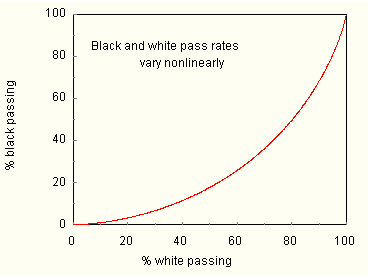
Basically, due to the distribution and mean IQ scores of different groups, the difference of frequency (percentage of any group scoring any given score) varies in a nonlinear way. See the chart below from La Griffe Du Lion:


Figure 6. Interdependence of group pass rates. Shown here for typical values of black and white distribution parameters.
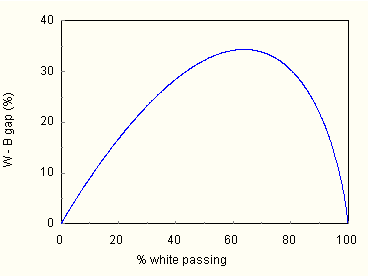
And with this we can now plot the predicted B/W IQ gap relative to any given white pass rate on any given test:

Figure 7. Predicted black-white point gap vs. white pass rate.

The predicted gap dependence shown in Figure 7 makes qualitative sense. Suppose an exam is so difficult that very few students pass, both black and white pass rates will be small, and consequently so will their difference. In the high-difficulty limit, the gap vanishes. At the other end, if a test is made so trivial that nearly 100 percent of all students pass, group pass-rate differences must again be small, and go to zero in the low-difficulty limit. Between these extremes the point gap attains a maximum value.


Now we have this chart based on percentiles, all we have to do is to figure out the percentile equivalent of any given IQ score. (Note: the percentile equivalents are not disaggregated for whites but finding disaggregated IQ distribution scores is impossible unless you are willing to pay)

Now we plot the Percent of Whites Making the Cutoff (scoring a given IQ score on a test) on to Figure 7 to get the White-Black gap in percentage points. Note: Even though the gap decreases the absolute ratio of black students to white students will still be disproportionate due to the demographics of the state.

The same thing can also be seen in this chart from the Wikipedia article on Race and intelligence (Average gaps among races)

As you can see, lowering the IQ threshold for the Gifted program in Florida from 130 to 120 will result in an greater ratio of whites to blacks to the program, even though more blacks will qualify. (Some of you might notice that this is basically the same sort of thing that educators do to reduce the achievement gap as measured against state standards. See Charles Murray's article on this here.)

Of course all this arbitrary setting of cutoff points doesn't mean anything in the real world because...

gifted education in most school districts sucks!

That's right, gifted education is for a large part a waste of resources.

Unfortunately, due to the political climate in education, educrats disdain for truly gifted students, and a tendency for educators to provide enrichment instead of acceleration, gifted students get shafted.

In some ways above average students are even more shafted than average students in our country. First of all gifted education usually disappears once students get into middle school, only to be replaced with honors and AP classes. And due to a prejudice against to much acceleration, young students who are probably capable of performing at several grades above the standards aren't given the opportunity. Instead they are saddled with all sorts of enrichment activities that usually involve some multidisciplinary project that emphasizes application of skills... bla, bla, bla.

Sure it appears to outsiders that gifted programs must work since the students are so bright, but they were bright before they got into the gifted program. Just as high SES schools appear to be successful based on the performance of their (mostly upper middle class white) students, gifted programs appear successful for the exact same reasons.

If Florida's law makers ultimate goal is to reduce the achievement gap, increasing the number of minority students in gifted education is not going to do it, but somehow I think its more of a numbers game that a true effort to improve educational opportunities.

Disclaimer: My son is in his 3rd grade gifted program and it sucks!

Note: Even if my logic about lowering the IQ threshold for gifted programs is totally screwed up, gifted programs still suck.